I am Bill Crawford. I was born and raised in Ft. Lauderdale, Fla., bisected by the Intracoastal. I graduated from the University of Virginia with a bachelor’s degree in commerce, with distinction, concentrating in finance. I obtained my juris doctor degree from Stetson University College of Law. I have practiced law for more than 43 years. I am a professional historian and author of the award-winning book, “Florida’s Big Dig,” (2008) the story of the Atlantic Intracoastal Waterway.
I have practiced law in Florida since 1975. Along the way, I developed a keen interest in researching and writing history, publishing numerous scholarly journal articles and one award-winning book, “Florida’s Big Dig,” the story of Florida’s Atlantic Intracoastal Waterway, using my legal pbackground to understand legal transactions, deeds, wmortgages, bonds, preferred stock, and legal descriptions of land and water.
In recent years, I have maintained a limited practice consulting with other professionals on various historical land and water issues, including sovereign, riparian, and submerged land rights, focusing on the Atlantic Intracoastal Waterway and Florida inland waterways.
I maintain a broad regular website here at www.floridasbigdig.me and a website solely on how the book was researched as well as some of the major themes explored. The website on the book itself is at www.floridasbigdig.com.
The website on contacts for professional services is at www.floridasbigdiglawyer.com?. A fifteen-page outline of my book
This is a forty-five minute documentary film. Having been the author of “Florida’s Big Dig,” I participated in the making of the Modern Marvels documentary on the Atlantic Intracoastal Waterway. I know that the organization makes every effort to get its facts straight because when I suggested changes in the script for accuracy, the producer/writer made them. Later, I asked the producer why he bothered to make the changes. His answer: he didn’t want to receive 10,000 letters telling them they were wrong! So, I can attest to their diligence.
What is fascinating in 2015 is that the Suez Canal Authority is embarking on a mega-project to enlarge the Suez Canal just as the Panama Canal finishes within the next six months its enlargement to compete for the business of the ever longer and wider new cargo vessel one thousand feet long and longer. Even more fascinating is that these two canals actually compete against each other for the world’s cargo business. A third competitor may be mega-cargo ships taking the arctic route to reduce mileage and increase efficiency.
Excitement builds as the Panama Canal begins filling in its new locks. The expansion of the canal by one-third will meet the demands of the next one hundred years as mega-cargo ships transit through the locks each ship carrying perhaps a third more cargo, making transportation through the Canal more economically efficient.
VIDEO: How water flows through Brandon Road LockRegion: Inland Rivers – Chicago to Mobile
Source: The Waterway Guide
Date Reported: Jul 9, 2015
Reported By: Mike Ahart, News Editor
Source: USGS
Courtesy of the US Geological Survey, this video portrays two areas near the Brandon Road Lock and Dam as the lock was emptied through the downstream valves, refilled with water, and then emptied again. Brandon Road (Illinois Wwy Mile 286)was selected as the newest location to install a “fish barrier” to prevent invasive Asian carp from reaching the Great Lakes watershed, in addition to the existing “Electric Fish Dispersal Barrier” located at Mile 296.1-296.7 on the Chicago Sanitary and Ship Canal.
From the USGS:
This video shows a split screen with three different panes. The left half shows a series of photographs from two cameras in the lock (left), and downstream of the lock (middle). The right side portrays the velocity vectors at an acoustic Doppler velocity meter located in the channel approximately 1,200 feet downstream of the lock. The arrows on the velocity vectors indicate what direction the water is flowing and the length of the velocity vectors indicate how fast the water is flowing. All photos and the velocity vectors are time synchronized so that the viewer may see how the changes in the lock level change the velocity in the downstream channel.
This data collection is supporting efforts to combat the spread of invasive Asian carp into the Great Lakes Basin. Brandon Road has been selected as a location to apply controls to stop the movement of these fish. To develop these controls, the hydrodynamics of the system must be well characterized by collecting flow and velocity data.
The line http://ensmble.net/track/the-study-of-life introduces us to a four-minute snippet to the “The Study of Life” from the album, “The Forest and the Sea,” by the Spanish musician Pyrenees.
The snippet above is intended to interpret a portion of “The Forest and the Sea,” a book on ecology written by Dr. Marston Bates fifty-five years ago. It’s free and you may copy it. You may buy the album for one euro or for any donation you may choose to make. What inspired the writer of the musical piece was the purchase of Marston’s book for one pound in London a few years ago.
As many of you know, I have tried my best to limit my subject matter to things of interest, some architecture, some art, a lot of community history, and even more about the inland waterways because my book and this website (I dislike the word blog) are about the Intracoastal Waterway, as well as some canals and inland waterways throughout the world in such places as France, England, Belgium, and The Netherlands. My allusion to Alfred Browning Parker’s emphasis on the importance of “Ecology” in 1966 in the last posting motivated me to take this little detour. This musing is a special delight to me. I hope you enjoy it as much as I did in putting it together. I must thank one of our loyal audience, Kay Larche, a committed environmentalist for pushing me in this direction.
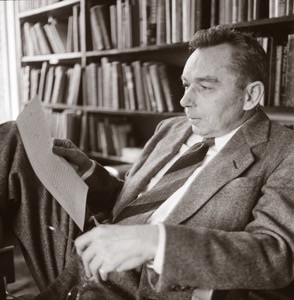
Dr. Marston Bates, in his study at the University of Michigan, Ann Arbor, Michigan.
Pyrenees’s album is a musIcal interpretation of “The Forest and the Sea,” by Dr. Marston Bates (1906-1974), acclaimed zoologist and early ecologist. Marston’s book, one of dozens written during his career, was penned to be an academic but popular comparison of the distinct ecologies of the forest and the sea.
I first became acquainted with Marston’s life and works when I served as president of the Fort Lauderdale Historical Society (2001-2005). I was rummaging through the Historical Society’s Library one Saturday when suddenly I saw several books on our shelves written by Dr. Marston Bates.
Now I knew that Marston’s father, Glenn, had been a conductor of the small Fort Lauderdale Orchestra in the early 1900’s and probably a music teacher and school band leader when Fort Lauderdale (Central) High School opened in 1913. Glenn’s ‘rag-tag’ city orchestra of older musicians played in the open air during the tourist season where Las Olas Riverfront is located, at the end of Brickell Avenue along the New River. A research center in Birch State Park bears Glenn’s name. Marston graduated from Fort Lauderdale High (Central) School in its early years. He married Nancy Bell Fairchild, daughter of botanist David Fairchild of Fairchild Tropical Gardens, and granddaughter of Alexander Graham Bell. Marston graduated from the University of Florida (1927), and later obtained his master’s (1933) and doctoral (1934) degrees in zoology from Harvard University.
He served as chair of the department of zoology at the University of Michigan where he taught zoology for the last twenty years of his teaching career (1952-1971), retiring because of illness at age sixty-five. Earlier in his career he studied the mosquito when he worked for the Rockefeller Foundation in a number of countries, including Italy and France in 1935. Marston lived for at least a year each in places like Albania, Colombia, Egypt, even an atoll in the South Pacific, continued studies elsewhere and during extended sabbaticals from different universities. His contributions to an understanding of the mosquito helped lead to the eradication of malaria and yellow fever. Marston was elected a Fellow of the American Academy of Arts and Sciences in 1958.
I’ve saved the most interesting for last. The last is an audibly clear recording of a lecture, one-hour long, given by Dr. Bates on December 12, 1955, in the auditorium of the New York Academy of Medicine and broadcast by WNYC educational radio for a series entitled,”Lectures to the Laity.” Dr. Marston’s topic: “The Ecology of Health.” Follow this link: http://www.wnyc.org/story/the-ecology-of-health/. And press the blue button. Withal, Dr. Bates never forgot us. Dr. Marston Bates was one of the founding trustees of the Fort Lauderdale Historical Society, Inc., chartered in 1962.
Approved tentative plan for the widening and deepening of port channels and turning basin
The legend shows the details of the plan, which you should study carefully. Although none of the expansion will be paid for by imposing increased property taxes on Broward County property owners, one should take heed of the amount of mangrove land to be eliminated to accommodate Port expansion in the light blue rectangle to the west (left). Under federal law, the Port must acquire an equivalent amount of mangrove lands to mitigate the destruction of environmentally sensitive lands.
Under the plan, the Outer Entrance Channel will be lengthened and widened. The box in purple called the Widener will increase the size of the turning basin for longer ships required worldwide by the Panama Canal expansion for some of the longest, widest, and heaviest cargo vessels in the World.the forest green box indicating the Inner Entrance Channels will be widened and deepened for traffic flowing to and from the south for loading or offloading.
The last two boxes in light green are increase space for Notches for Turning and Berthing or just Turning. The remainder of the colored boxes and lines are as described. Study them carefully. The Plan represents a the Port’s future, a major enterprise operated by Broward County, Florida.
Valley Palooza hits the ICW, July 5
Region: Atlantic ICW – FL & St. Johns R.
Date Reported: Jul 2, 2015
Reported By: Mike Ahart, News Editor
Source: Coast Guard News
Coast-Guard-Reponse-Boat.jpgWatch out for a raft of rafts – it’s a floating party on the ICW around Mile 755 on Sunday, July 5, 2015, according to a Coast Guard News report:
The Coast Guard, along with the Florida Fish and Wildlife Conservation Commission and St. Johns County Sheriff’s Office, are set to conduct patrols, Sunday, throughout the Intracoastal Waterway in the vicinity of Palm Valley, Florida, in conjunction with the planned Valley Palooza event.
This is the first year for the Valley Palooza event that involves participants aboard inflatable rafts in the Intracoastal Waterway.
Coast Guard on guard July 5th, 2015, for untoward party activities during the Palooza event at the ICW and the vicinity of Palm Valley Bridge.
During the event, Coast Guardsmen from Coast Guard Station Mayport will join members of FWC and St. Johns County Sheriff’s Office and conduct patrols throughout the area. The purpose of the patrols is to ensure safety for those attending. The ICW is a heavily-used waterway and the presence of small rafts could pose a danger to those in them and to boaters transiting the area. Boaters should exercise caution while transiting the ICW in the vicinity of Palm Valley from 11 a.m. to 2 p.m.
Officers with the Coast Guard, FWC and St. Johns County Sheriff’s Office will be looking for boaters who are intoxicated and operating their vessels recklessly on the waterways. Boaters are advised to have a designated boat operator if they plan to consume alcohol while out on the water.
On Friday, June 26, 2015, the the Chief of Engineers of the U.S. Army Corps of Engineers recommended to Congress the expansion of Port Everglades, Fla., as requested by the Broward County Commission.
Broward County has now been given the ‘green light’ to allow the Port to compete with many of the ports on the Atlantic coast for cargo business transiting through the expanded Panama Canal, expected to permit the transit of large mega-cargo ships plying the Seven Seas when construction is complete. A few status videos may be found in the posts throughout this website. Few ports on the Atlantic coast are expected to have the capacity to berth the large mega-cargo ships of the new millennium. Jacksonville has declined to expand its port to compete for this new business (Jaxport to WGC, April 3, 2015).
Approved tentative plan for the widening and deepening of port channels and turning basin.i
There are significant barriers the County must overcome before breaking ground on the project. One controversial obstacle is the required destruction of a number of acres of mangrove plantations to accommodate the expansion. Under federal law, the Port will be required to mitigate the destruction by planting a substantial number of acres of mangroves in other areas of the County.
Plans call for a partnership between Broward County, Fla., and the Army Corps of Engineers that may last for several decades. Although county property taxes might ordinarily increase, the project will not increase local property taxes. The improvements will be paid for by users of the port and anticipated federal grants.
U.S. Drought Monitor http://www.drought.govView Originalu.s.drtmon6.23.2015
The U.S. Drought Monitor is unique, blending numeric measures of drought and experts’ best judgment into a single map every week. It started in 1999 as a federal, state, and academic partnership, growing out of a Western Governors’ Association initiative to provide timely and understandable scientific information on water supply and drought for policymakers.
The Monitor is produced by a rotating group of authors from the U.S. Department of Agriculture, the National Oceanic and Atmospheric Administration, and the National Drought Mitigation Center. It incorporates review from a group of 250 climatologists, extension agents, and others across the nation. Each week the author revises the previous map based on rain, snow and other events, observers’ reports of how drought is affecting crops, wildlife and other indicators. Authors balance conflicting data and reports to come up with a new map every Wednesday afternoon. It is released the following Thursday morning.
Visit the US Drought Monitor for the current drought conditions by merely touching or inserting the following line in your Adobe .pdf browser: 20150623_usdm.pdf
The Map shows conditions as of 8 a.m.,Tuesday,June 23, 2015. Areas shown in a wine-red/brownish color as in California are calculated to be “Exceptionally Dry.” Spots of yellow throughout the nation indicate “Abnormally Dry” conditions.
One of the world’s most famous nautical museums is Mystic Seaport located at Mystic, Conn. on Long Island Sound and Long Island. It newest addition is the Thompson Exhibition Building. The replica 18th-century French frigate Hermione arrived in Yorktown to make her visit to America, while the world’s oldest commissioned warship afloat, the U.S.S. Constitution, arrived for needed repairs in dry dock.
From June 25th through June 28th, small craft registered boaters will share their craft with others. During the same time period more than 100 traditional and classic wooden boats of every type may be seen at the 24th Annual Wooden Boat Show. In addition to exhibitions, Mystic Seaport boasts some of the largest collections of maritime books, archives, collections, and ephemera.
The author has always maintained that the lifeblood of every nonprofit charitable organization is its body of volunteers. Hardcore and committed enough to volunteer their time to a worthwhile organization, these volunteers become regular members, annual and year-end plus-givers, large gift lifetime donors, gift annuitants, and large deferred donors whose motivations may but not always include some tax planning. But the bottom line is always a love for the organization. Mystic Seaport boasts “600 dedicated volunteers.” There are few organizations across America that can lay claim to a number of volunteers even close to the number who volunteer at Mystic Seaport. Something good must be going on at this museum!
Part I of the restoration of the Kissimmee River basin. Unimpeded, southerly river flows in a sinuous, winding pattern, ultimately draining into Lake Okeechobee, were essential in maintaining a unique subtropical ecosystem that had existed for centuries. This ecosystem helped maintain the diversity of wildlife in the region as well as the health of Lake Okeechobee.
A series of heavy tropical storms and a particularly rain-soaked 1947 hurricane persuaded policy makers to channelize or straighten unwisely the once tortuous Kissimmee River. Channelization or straightening of the Kissimmee disrupted this century’s old ecosystem, drying up wet areas and lakes. Birds and other animals from the smallest microorganisms to the Florida panther dependent on the pre-existing ecosystem soon died off, destroying a functioning ecosystem. Agriculture also introduced phosphorus and fertilizer products that sped up the population of cat tails and other invasive plants, drying up over time clean water and leaving “dirty” water behind.
In recent years, the Army Corps of Engineers and the South Florida Water Management District have joined together to restore the traditional flows of the river and clean water in one of the largest federal-state-industry cooperative construction projects in American history. This film illustrates the beginning stages of restoration.


 Florida’s Big Dig