Florida’s Big Dig

The story of the Intracoastal and other thoughts on water, waterways, land, and ecology

  • Completed in 1829 during the first great Canal Era when arguments over Constitutional restraints kept Congress from using Federal taxpayer money to fund inland waterway construction, a private company completed the 17-mile waterway between the Chesapeake and Delaware Bays.

    The original waterway was a tollway ten feet deep and sixty-six feet wide, with a boat channel thirty-six feet wide. It had four locks, each 110 feet long and 22 feet wide, later enlarged to 220 feet long and 24 feet wide.  The canal system later gave way to the faster and more economical railway by the time of the Civil War.

    Today, the Canal has 5 fixed bridges and one lift bridge.  The four locks have been removed. The Chesapeake and Delaware Canal serves as an important inland link in the Atlantic Intracoastal Waterway from Boston to Miami.

    To see a short film of a boat transiting the Canal, Tap on this:

  • The oldest working canal still in existence, the Dismal Swamp Canal transits through naturalistic views of North Carolina and Virginia. This short video captures a history of the waterway three centuries long, beginning with some of the founders of the Nation making plans for a waterway between North Carolina and Virginia. [Tap the following to play video]

  • image

    By November 1912, according to the terms and conditions of the Settlement Agreement made in 1906, the last of twelve deeds had been delivered by the State of Florida Trustees of the Internal Improvement Fund (the State Cabinet) to the Florida canal company conveying in the aggregate more than one million acres of prime east coast land for dredging 268 miles of Intracoastal Waterway from Jacksonville to Miami.

    Under the 1906 agreement, state legislators had given the canal company more time to finish the waterway and more state land if the canal company dredged an additional 30 miles north of St. Augustine to Jacksonville. In 1914, many stretches of the waterway had not been completed to state specifications. The state had required a canal five feet deep and fifty feet wide. In many cases, embankments as in this photograph slid back into the water, requiring remedial work.

    At the same time, shippers, business and trade associations complained that the State should not have given the last of the twelve deeds for work that had not been completed or completed incorrectly. The photograph plainly shows a deficiency of retaining walls or their equivalent to keep dredged material from sliding back into the canal by 1914.  Unfortunately, the State’s original specifications called for “maintenance” of completed work to be paid for out of toll money collected but little else in specifying precisely how the waterways were to be maintained.  

    Courtesy, Boynton Beach Historical Society/Janet DeVries.

  • Commodore Avylen Harcourt Brook


    Commodore Avylen Harcourt Brook was born in Sheffield, England, in 1866 into a family of silver and bronze electroplaters. His early education was in England. Brook studied art under the famous English artist and critic John Ruskin. It was said that one of his ‘parlor tricks’ was to paint two paintings simultaneously, one with his right hand, the second with his left hand.

    He migrated in his early teens to Brooklyn, New York, where he soon became president of the Thomas Cusack Outdoor Advertising Agency. There, Brook created the famous Maxwell House “Good ’til the last drop” neon sign and turned Broadway into the ‘Great White Way’, with advertising signs everywhere in neon lights. As president, Brook was earning $25,000 a year, a princely sum in those days.

    In 1919, at the age of 53, Brook retired. He sailed his 22-foot sloop ‘Klyo’ down the Atlantic coast to Fort Lauderdale where he lived in a modest residence named ‘Brookside’ on the New River; his sloop ‘Klyo’ docked in the back on the River. Brook had acquired the title Commodore from his leadership of at least two yacht clubs on the Long Island Sound. Brook had been a member of various groups that promoted the construction of a continuous inland waterway inside the Atlantic coast. In Fort Lauderdale, Brook represented Broward County as a member of the Florida Inland Navigation District (FIND), tasked with the duty of acquiring the old Florida East Coast Canal tollway and turning it over to the federal government for enlargement and perpetual maintenance.  When Brook died, downtown retailers closed for half a day in respect for Brook’s contributions to the community.

  • image

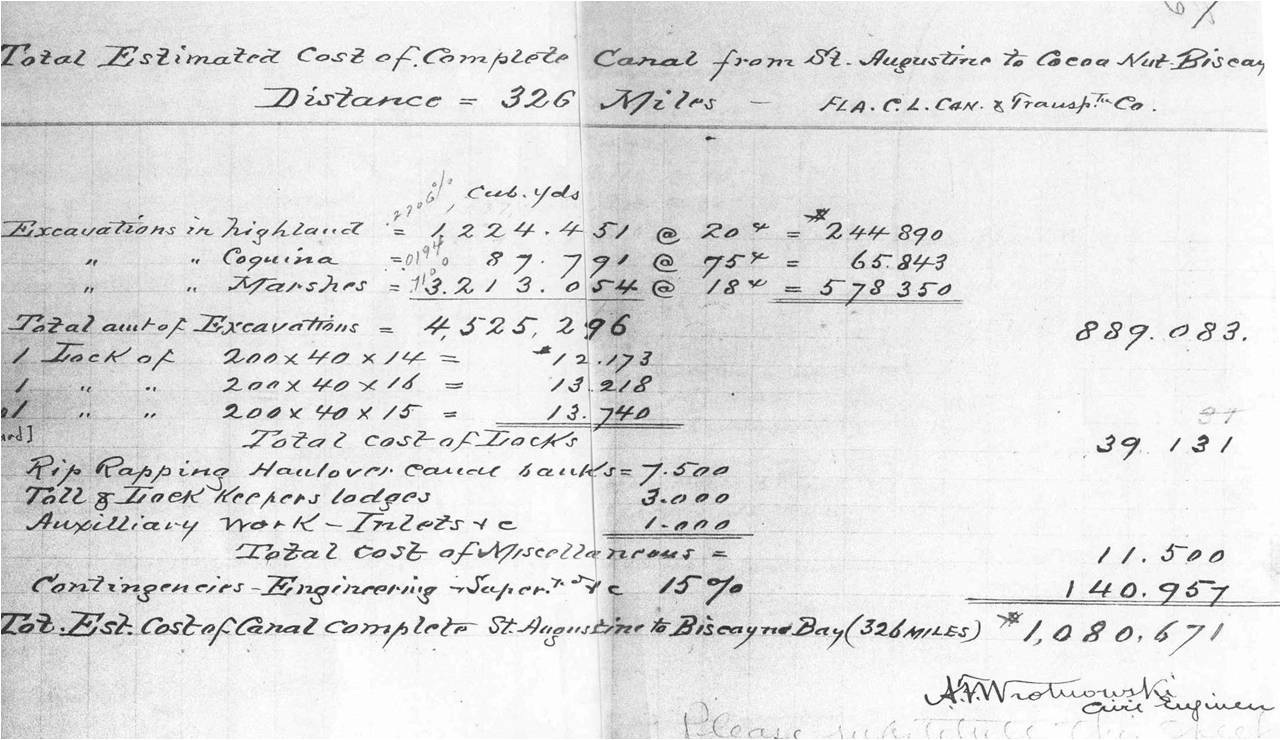
    In 1888, Florida canal company general manager George F. Miles engaged acclaimed Chicago waterway and railway engineer Elmer Corthell to survey the soil, rock, sand, and other material the Company dredges would likely encounter in completing the waterway and to estimate the cost of completion.

    In turn, Corthell employed a former Army engineer, Artur [sic] Wrotnowski, to perform the actual on-the-ground measurements between bodies of water, their depths, and distances, with calculations of how much material the Florida canal company would have to move to comply with state requirements. Corthell reviewed Wrotnowski’s survey in detail and reported to the directors of the Florida canal company the amount of material to be moved and the cost to complete the waterway.

    Corthell also considered mounting marine vessels on railway cars to transit difficult-to-dredge dry land between waterways but rejected the railway alternative as too expensive to maintain. In conclusion, Corthell endorsed the project on a ‘pay as you go’ basis, starting with minimum depths now, using the waterway to generate revenue to dredge a deeper and wider waterway later.  Withal, Corthell thought the Florida East Coast economy robust, more than enough to justify his estimated cost to complete of a little over $1 million in  1889 ($26 million in historic standard-of-living dollars today, 2014). Courtesy, Brown University, Hay Library, Providence, Rhode Island.

  • image

    Sketch of survey of Lake Boca Raton, Boca Raton, Florida, made by Arthur Wrotnowski, Civil Engineer, for a Report on the Florida East Coast Canal (Intracoastal Waterway) from Jacksonville to Miami, Florida in 1889 by Elmer Corthell of Chicago, Illinois. The report was undertaken to encourage New England investors like Bradley and Albert P. Sawyer of Newburyport, Mass. To invest in the waterway’s dredging. Courtesy, Hay Library, Brown University, Providence, R.I.</

  • image

    Unlike the Federalists who believed that the Constitution authorized a full-time standing army, the nation’s third president Thomas Jefferson signed into law the Military Peace Establishment Act (1802). The Act founded the U. S. Military Academy at West Point to train engineers skilled in surveying and planning military roads, inland waterways and constructing bridges, harbors, and lighthouses. But with one crucial caveat.  The Constitution, Jefferson argued, prohibited the spending of federal tax money for internal improvements like bridges,, roads, and harbors.  For decades the fight between Anti-Federalists like Jefferson and Federalists like Alexander Hamilton who took a broad view of the Constitution held up the construction of necessary internal improvements dependent on federal tax money.  

    One particular fight was especially interesting.  While Congress finally decided that the construction of lighthouses was in the nation’s best interest, Congress would agree to fund the construction of a lighthouse in one of the thirteen original states only if that state agreed to provide the land, free and clear, to the federal  government. 

    General Quincy Adams Gillmore graduated first in his class at West Point. Among his early assignments in tthe 1870s was the study of the Mississippi River and its annual flooding.  Gillmore later became chief of the Florida engineers, superintending several inland waterways that would eventually become part of the Atlantic Intracoastal Waterway. But the long-held view that internal improvements should be left to the States continued to hold up the federal funding of roads and inland waterways.  Courtesy, U.S. Army Corps of Engineers.

  • Sunset at Hilton Head Island Overlooking the Intracoastal Waterway
    Sunset at Hilton Head Island Overlooking the Intracoastal Waterway

    Taken at sunset from the Lighthouse Marina at Sea Pines Plantation, one of the largest plantations on Hilton Head Island, South Carolina, with several yachts docked awaiting the arrival of more marine vessels for Memorial Day festivities.

    Beyond the marina, Calibogue Sound is one link in the Atlantic Intracoastal Waterway and the second largest sound on the Atlantic seaboard. Because no state on the Atlantic seaboard except the State of Florida funds a governmental entity to maintain the Waterway through its state, states like South Carolina must rely on federal funds and the Army Corps of Engineers for dredging and other operational maintenance.

    For at least two decades, there has been a shortage in federal funds to maintain the Waterway. Fortunately, the State of Florida has the Florida Inland Navigation District (FIND) to pick up the slack.  The rest of the states experience low water and damaged boats from a lack of  dredging, particularly in stretches in and around Hilton Head.

  • Steamer "Swan" Schedule of Tolls, 1911

    As the 1912 deadline approached for the completion of the Florida waterway, George Francis Miles became increasingly disenchanted with his role as general manager of dredging operations.  In 1911, Miles and others organized the Florida Coastal Inland Navigation Company to run steamboats on the completed portions of the inland waterway (Florida East Coast Canal).  

    Shown here is the toll schedule of the new steamer company running the old “Swan,” a light draft flat-bottom sternwheeler that once ran cotton on the Mississippi River.  The “Swan” now transported cargoes of winter vegetables and citrus or passengers with their automobiles stowed in the open on the first level.  Courtesy, Florida State Archives, Tallahassee, Fla.

  • FIND 1928
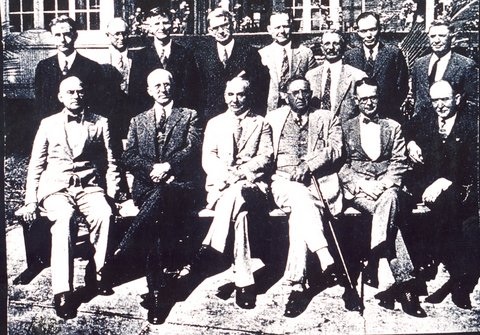
    The first Board of Commissioners of the Florida Inland Navigation District (1928). Courtesy, FIND.

    Of all the coastal states contributing inland waterways that now make up the Atlantic Intracoastal Waterway, only the State of Florida was required to buy its waterway for turnover to the federal government free of charge. For example, the Commonwealth of Massachusetts was not required to buy the privately owned Cape Cod Canal built by August Belmont for turnover to the federal government free of charge.

    Congress appropriated the funds to buy the Massachusetts waterway. The Florida legislature created the Florida Inland Navigation District (FIND) to float the bond issue at Florida taxpayer expense to buy the Florida East Coast Canal for turnover to the Corps of Engineers for enlargement and perpetual maintenance. FIND’s commissioners included yacht club commodores, newspaper publishers, and real estate developers. FIND issued a million dollars worth of bonds to buy the waterway for $725,000 and to acquire the right-of-way for the waterway’s enlargement. In the end, commissioners ‘burned’ the bonds not needed for the project, a result rarely seen in modern-day public works.