Florida’s Big Dig

The story of the Intracoastal and other thoughts on water, waterways, land, and ecology

  • http://video-monitoring.com/beachcams/jupiter/slideshow.htm?station=Panorama#

    A number of universities and independent scholars have been studying the effects of wind and wave action upon our shorelines. In 1924, a number scholars and politicians formed the American Society of Shoreline and Beach Protection.

    Even before the incorporation of this Association, the Army Corps of Engineers had been studying the effects of waves upon shorelines on harbors for national defense and the use of rip-rap and jetties to divert ocean currents in an effort to keep harbors from becoming impassable.

    Several years ago, I was invited to board the Corps of Engineers’ (Survey Vessel) S/V Floridafor the annual inspection of a stretch of the Intracoastal Waterway, as required by federal law. One of the experiments the Corps had undertaken was the planting of new shoots of mangrove eroded away by the fast moving Jupiter Inlet current.

    The Corps inserted hundreds of shoots inside PVC piping to protect the young mangrove shoots from destruction by the fast-moving current. Several years later, from what we could observe, the young plants had taken root. Today, the plantings are thriving.

  • Matanzas Inlet -South St. Johns County
    Matanzas Inlet -South St. Johns County
    In 1881, the private St. Augustine-based Florida canal company agreed to dredge an inland waterway from Miami, Fla., to St. Augustine, Fla., and later to Jacksonville, Fla., a distance of approximately 400 miles. For every mile of waterway dredged, state legislators agreed to convey to the canal company 3,840 acres of state-owned land. Upon the delivery of the last (12th) deed to the canal company, the State had granted the canal Company a little over a million acres of public land.

    Of the total length of the waterway, between 80% and 85% of the total was pre-existing waterway. Nonetheless, of that 80% to 85% of the waterway, much of it required the dredging of safe, uniform channels as we see them today in the Intracoastal Waterway.

    Moreover, both artificial and natural inlets dot Florida’s east coast making difficult maintenance of the waterway at these points. Natural littoral drift along the entire Atlantic coast would routinely fill up these inlets and the Intracoastal Waterway. Some inlets like the Hillsboro Inlet have special navigation districts formed for the purpose of addressing littoral drift. In his report of 1889, Corthell opined that inlets would bring sea water into the inland waterway and naturally kill off fresh water plants such as the hyacinth that often clogged the waterways, representing navigational hazards.

  • Florida canal company (private) toll schedule (1920). Courtesy, Youngberg collection, Rollins College, Winter Park, Fla.

    Evidence is scant but it appears that State trustees first permitted the private canal company to collect tolls from vessels transiting the inland waterway at various points in 1911. The method of collection was to stretch chains across sections as narrow as fifty feet. When the vessel paid the toll exacted, the toll keeper relaxed the chain to the bottom of the waterway, thus allowing the vessel to pass.

    By 1920, as many as six chains were stretched across the waterway at six different points from Jacksonville to Hallandale. The number and location of the chains depended on the amount of tolls collected from each section. Oftentimes, the State trustees (the Cabinet) would move the toll chain from Dania (Beach) to Hallandale (Beach); at other times, the trustees would suspend collections entirely upon evidence that the tolls collected did not justify maintenance of the chain and the salary of the toll keeper.

    As late as 1925, just before the collapse of the real estate market and the Hurricanes of 1926 and 1928, toll collections amounted to an astounding $50,000 in one year.

  • Cape Canaveral Light established in 1848 is 151' tall. A foundation that supports the lighthouse will hold its 9th annual Lobster Fest on March 7, 2015.
    Cape Canaveral Light established in 1848 is 151′ tall. A foundation that supports the lighthouse will hold its 9th annual Lobster Fest on March 7, 2015.
  • The development of the lighthouse in the United States, particularly in the New England states is a lesson in the doctrine of federalism, a lesson in the history of early colonial America.

    In the beginning, America was a confederation of separate colonies. Each had its own coinage, import and export policies, and separate obligations to provide for the common defense. Under the Articles of Confederation, the obligations of the colonies were spelled out with no obligation on the part of the colonies as a whole to defend an attack on one colony and no ability of the confederation to impose taxes on all of the colonies as a whole.

    Upon the adoption of the Constitution, the federal government had certain specified powers. But to the extent no specific power was vested in the federal government, such power was vested in the states or in the individual. This was a unique change in government. The people governed themselves through the right to vote and on the limitations placed on government itself by the people.

    When the thirteen colonies under the new Constitution saw the need for lighthouses to guide ships along the Atlantic coast, there was no power vested in the new Congress to impose taxes and build lighthouses. Such power appeared to be reserved to the states and to the individual. Eventually, Congress reached a compromise. If the States provided the land, the federal government through the Army Corps of Engineers would provide the lighthouse and its keeper.

    The idea of shared power and responsibility would grow to include a broad range of powers and responsibilities under the Commerce Clause, the Common Defense clause, and the Common Welfare clause.

  • Built in the 1860’s, the Jupiter Inlet Lighthouse is a natural entry point onto the Jupiter River and the Intracoastal Waterway at Jupiter, Florida, in Palm Beach County. Each year, hundreds of recreational and commercial vessels transit through the Inlet to a leisurely cruise along the coast or to the Caribbean Sea for serious deep sea fishing.

    Designed by U.S. Army General George Meade, who later won acclaim on the battlegrounds at Gettysburg, Pennsylvania.

    This lighthouse has guided ships of all sizes and types safely through the inlet for over 150 years and survived many hurricanes and tropical storms that typically plague the southern coast of Florida during the summer months.

    Equipped with the world renowned French-designed Fersnel lens, a small amount of light can be magnify light to guide ships at sea as far away as fifteen miles from the the coast,

  • The Ponce Inlet Lighthouse is approximately 20 miles south of St. Augustine.

    Well-hidden behind a curved inlet and lush vegetation, the Ponce Inlet Lighthouse, formerly known as the Mosquito Inlet Light, is the tallest lighthouse in the State of Florida.

    Constructed in 1836 but only first lit in 1887, this lighthouse composed of brick in a conical design reaches 175 feet into the sky.

    Lit by various orders of Fresnel lenses at various times, the light can be seen by ships as far as 17 miles away. Restored by a non-profit organization, it became a National Historic Landmark in 1998.

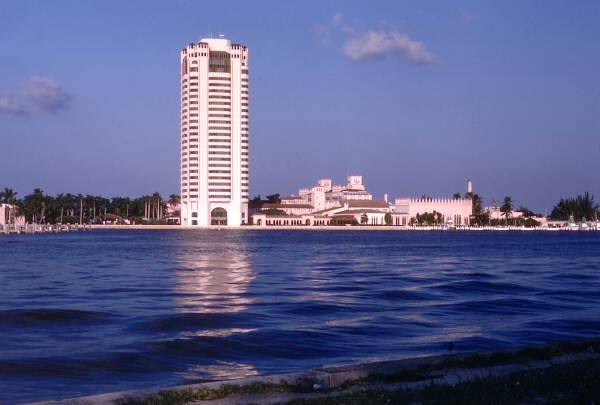
  • Lake Boca Raton and Boca Raton Hotel & Club (in the background)
    Lake Boca Raton (foreground) and Boca Raton Hotel & Club (in the background. 

    The 1889 Corthell survey of the Florida East Coast Canal showed the Lake at 5′ – 9′ deep with a forty foot bluff along the near, east (Atlantic Ocean) side of the Lake.  While four feet would have satisfied state specifications in 1881 (3′ then), by 1889 that depth would not have been navigable for most purposes, nor would it have satisfied the new minimum at that time of five feet deep.

    Today, the Intracoastal Waterway runs through Lake Boca Raton from south to north. The same shallow conditions prevail except for a narrow, dredged marked route through the Lake. Interestingly, except for the channel marked for the Intracoastal Waterway, during weekend low tides, power boats congregate and raft with each other, party-goers exit their boats and literally walk in the shallowest parts of the center part of the Lake. Even the children walk in the shallow water. It’s party time!

    This Lake and other lakes, rivers, and lagoons along the Florida East Coast Canal had water present throughout the year but for all practical purposes these watercourses were non-navigable to all but the lightest flatboat steamers and light draft sailboats. Dredging was required despite the presence of water.

  • <img class="size-full wp-image-2570" src="https://floridasbigdig.me/wp-content/uploads/2015/01/image6.jpg” alt=”Hillsboro Inlet and Lighthouse (1903), relatively current photograph.” width=”600″ height=”616″ /> Hillsboro Inlet and Lighthouse (1903), relatively current photograph.

    This photo shows the lighthouse on the north side of the inlet, Intracoastal continues north between Town of Hillsboro Beach to the right and the City of Lighthouse Point to the left of the ICW.

  • [Push box link above with force several times to unload the entire Wikipedia article]

    After six years of construction, this inclined plane boat lift eliminated 14 canal locks when it opened in 1968. The system uses two large caissons (299 feet long and 39 feet wide) filled with water and mounted on rails along with counterweights to move the caissons filled with water and boats. Each caisson can carry either one boat with a maximum displacement of 1,350 tons or several boats totaling 1,350 tons. The vertical distance traveled is 222.2 feet and a length of 4,689 feet.