Florida’s Big Dig

The story of the Intracoastal and other thoughts on water, waterways, land, and ecology

  • Florida gray Ibis.

    The Florida gray Ibis in its wet,marshy habitat.

    It consumes the smallest sea animals, mollusks, and sea grasses.
    In turn, larger predators like snakes and alligators occasionally find sustenance in consuming the Ibis. In the early 1900’s, Florida women leaders like Ivy Stranahan led the fight in stopping the hunting of water birds solely for their plumes, making it a criminal offense.

  • Turnstyle Bridge across the Intracoastal Waterway at Fort Lauderdale
    Turnstyle Bridge across the Intracoastal Waterway

    At Fort Lauderdale, the first bridge to the beachside was a short wooden bridge across what then known as the private Florida East Coast Canal ca. 1910. Located on the north side of the land was a small wooden house occupied by the bridge-tender and his family. Upon the approach of a small boat or light draft barge, the tender would exit his house and turn the bridge ninety degrees with a long pole inserted like a ‘key’ in the middle of the bridge roadway.

    Some years after 1929, the Army Corps of Engineers widened the Intracoastal Waterway (ICW)  to at least 125 feet, removing the turnstyle bridge, the spit of land in the middle of the Waterway and the fixed bridge west of it. My best guess of the date the photo was taken is in the 1930s.

    In the mid-1950s, a double-bascule bridge replaced the fixed bridge, the small island, and the old turnstyle bridge, connecting the mainland to the beaches. It was dedicated in memory of Dwight Laing Rogers, Sr., M.C., who died unexpectedly in 1954. As a Florida state representative, Rogers authored the homestead exemption saving many residences of the head of a household from seizure and sale for non-payment of property taxes during the Depression. Courtesy, Bridge-tender’s daughter, Jeri Burrie Howard.

    .

  • The ubiquitous panda

    After escaping from Panda prison in China for having too many babies, Panda crossed the Bering Straits, making her way down the California coast to Tinsel-town, where she made three 3-D movies with Jim Carrey; a career in movies seeming much too dull and unrewarding, Panda again escaped to San Diego to a peaceful, carefree life of eating bamboo sprouts. Most entertaining is looking at hundreds of thousands of funny people with cellphones taking photos of themselves. Don’t they know who they are? Or do they forget what they look like?

  • Florida Amaryllis

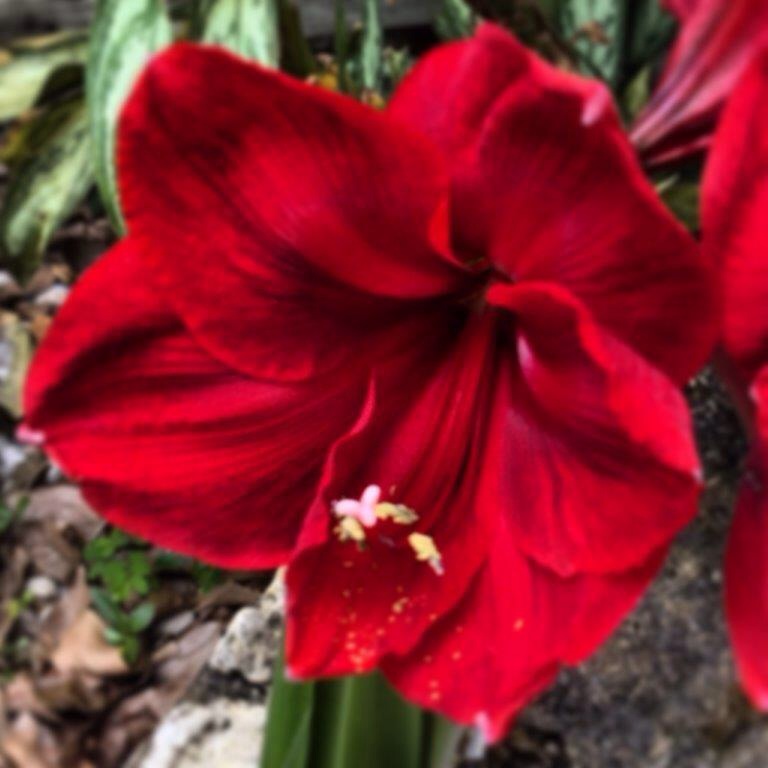
    Florida Amaryllis in bloom in spring.

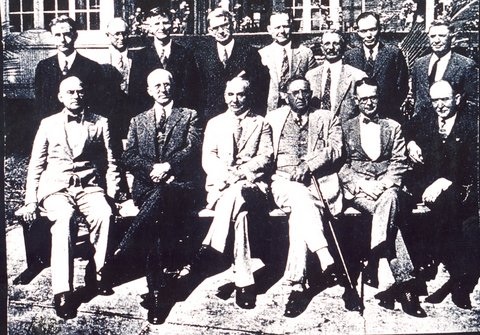
  • 1927 Florida Inland Navigation District Commissioners Negotiating the Purchase of the Waterway

    Assembled here with a few exceptions are the eleven commissioners of FIND appointed by Florida Governor David Sholtz to purchase the old Florida East Coast Canal (“the Canal”) from Harry Kelsey (1st row, 2nd from the right) for turnover to the Federal Government for enlargement and perpetual maintenance as the Intracoastal Waterway.

    Erstwhile New Jersey restauranteur, Kelsey sold all of holdings to begin developing more than 100,000 acres of Palm Beach County beginning in 1919. When Kelsey bought the Waterway in 1925, Kelsey intended to use the Waterway to transport building materials to his various developments including Kelsey City, employing John Nolen and the Olmstead Brothers to plan the City. Today, Kelsey City is known as Lake Park, Fla. Kelsey paid $550,000, almost all of it in the form of installment notes. Kelsey defaulted except for the down payment.

    Others depicted in the photograph are newspaper publishers, real estate developers, and yacht club commodores as commissioners. Commodore Brook of Ft. Lauderdale is the short-statured, stout fellow with the bushy handle-bar mustache in the back row, third from the right. The chairman, Charles F. Burgman (front row, fourth from the right), Daytona publisher and developer, won his post by the ‘flip of a coin’. Courtesy, FIND.

  • 1959 Gold Coast Marathon from North Miami to West Palm Beach on the Intracoastal
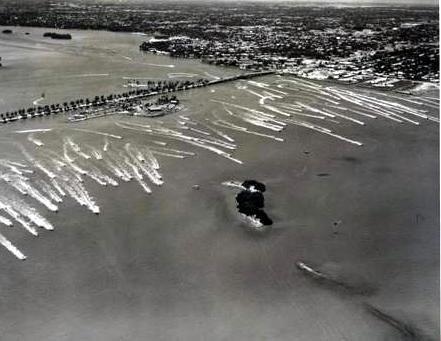
    1959 Gold Coast Marathon from North Miami to West Palm Beach on the Intracoastal

    From 1949 until sometime in the early 1970s, speed boat enthusiasts raced in the Gold Coast Marathon, an unlimited race with as many as 13 classes from the Pelican Harbor Yacht Club at the 79th Street Causeway to West Palm Beach and back the following day. The brainchild of Sam Griffiths, founder of the Pelican Harbor Yacht Club, Griffiths himself was a powerboat racer who won the first Marathon and two others. Top finishers completed the first 67-mile leg in one hour. The very best drivers in hydroplanes topped 100 miles per hour in the fastest stretches of the race course. In later years, the Marathon moved to the new Miami Marine Stadium amidst safety concerns when scores of small boats entered the race. Toward the end, the Marathon garnered the sanctioning of the prestigious American Power Boating Association. The long-abandoned Stadium is now in the hands of preservationists who hope to restore the Stadium to its former beauty and style along with educational programming.

  • 1892 color map of the lands of the Florida canal and Boston & Florida land companies
    1892 color map of the lands of the Florida canal and Boston & Florida land companies

    This rare map was found in the Trent University archives, Peterborough, Ontario, Canada. It shows the state lands reserved for granting to the Florida canal company in yellow and the lands of its affiliated land company, the Boston & Florida Atlantic Coast Land Company, in blue.  Each square block represents a “section” or one square mile of land. The larger squares represent townships, comprised of 36 sections or 36 square miles.

    Several of the investors in the canal company organized the Boston & Florida land company to buy 100,000 acres of the Florida canal company at a dollar an acre. Sir Sandford Fleming, chief engineer of the Canadian Pacific Railway soon became the land company’s largest stockholder. The participation of Canadian investors in Florida as early as 1892 has been a little known fact in Florida history. This map was so large that Trent University could not scan it as one continuous document. Hence, it had to be broken up and scanned in three separate sections. Is there enough interest in seeing the middle and southern east coast of Florida ca. 1892? Courtesy, Trent University, Peterborough, Ontario, Canada.

  • Writing can often be very frustrating!

    I remember being in grade school having to write my first essay. The topic was simple. “What did you do this past summer?” My palms became sweaty. This pit in my stomach began to swell. I literally froze. I couldn’t think of anything. Then I thought what we did on our family vacation. But I couldn’t put it into words.

    Fast forward forty years. I practiced law full-time and worked on short articles on history. I learned how to write like an historian. My first book was met with a five-page response from the first publisher. She basically told me what was wrong with it. And, if I cared to resubmit it, I could, but I would have to point out the places where I changed it. I was devastated. I had worked ten years on the book. I thought it was perfect. What does some book editor know about the history of the Intracoastal Waterway? I deemed her response a humiliating rejection. And…I went into a blue funk for six months. I couldn’t look at the manuscript, it was so depressing.

    I finally started to rewrite the entire book. A friend asked me if he could read the manuscript. Two weeks later, I got a contract in the mail. Florida’s Big Dig, the story of the Intracoastal, is finally in print. Unbeknownst to me, the publisher submitted my book for the top award for a scholarly book on a Florida history topic. I won the Rembert Patrick Award: a little round medal and some money to cover gas and the hotel room for the ceremony. Seven years later, the book is still in print. The research is solid and important. I expect it to be around for a very long time.

    Don’t give up. Read the best books by the best authors. And write every day. Cartoon, courtesy of Chan Lowe.

  • Dedication of the Commodore A. H. Brook Causeway in Fort Lauderdale (1956)

    Often referred to by residents as the “17th Street Bridge,” the Commodore Avylen Harcourt Brook Memorial Causeway (and bridge) over the Intracoastal Waterway was dedicated in 1956 in memory of the man most responsible in Fort Lauderdale for a Federal takeover of the old privately owned Florida East Coast Canal and its conversion into the modern toll-free Atlantic Intracoastal Waterway.

    Built between 1881 and 1912 the owners of the old canal from Jacksonville to Miami collected tolls from marine traffic yet still failed to maintain it. In 1927, the State of Florida created the Florida Inland Navigation District (FIND) to issue bonds to purchase the old Canal and any necessary right-of-way for turnover to the federal government.  In 1929, FIND turned the Canal over to the Federal government for enlarging and perpetual future maintenance. The toll chains used for collecting tolls were removed. This bridge memorialized Brook’s work in getting the federal government to take over the old Canal and improve it. Several years ago, this bridge was demolished and replaced with a new bridge named after Congressman E. Clay Shaw, Jr., who secured substantial federal funds to build the new bridge. Signs along the causeway road, however, remember Brook’s work. Postcard collection of the author.

  • JFlorida Croton

    There may be as many as 17 varieties of croton in Florida.