I am Bill Crawford. I was born and raised in Ft. Lauderdale, Fla., bisected by the Intracoastal. I graduated from the University of Virginia with a bachelor’s degree in commerce, with distinction, concentrating in finance. I obtained my juris doctor degree from Stetson University College of Law. I have practiced law for more than 43 years. I am a professional historian and author of the award-winning book, “Florida’s Big Dig,” (2008) the story of the Atlantic Intracoastal Waterway.
I have practiced law in Florida since 1975. Along the way, I developed a keen interest in researching and writing history, publishing numerous scholarly journal articles and one award-winning book, “Florida’s Big Dig,” the story of Florida’s Atlantic Intracoastal Waterway, using my legal pbackground to understand legal transactions, deeds, wmortgages, bonds, preferred stock, and legal descriptions of land and water.
In recent years, I have maintained a limited practice consulting with other professionals on various historical land and water issues, including sovereign, riparian, and submerged land rights, focusing on the Atlantic Intracoastal Waterway and Florida inland waterways.
I maintain a broad regular website here at www.floridasbigdig.me and a website solely on how the book was researched as well as some of the major themes explored. The website on the book itself is at www.floridasbigdig.com.
The website on contacts for professional services is at www.floridasbigdiglawyer.com?. A fifteen-page outline of my book
As early as 1822, before Florida had even attained statehood in 1845, the Army Corps of Engineers had reported to Washington the desirability of building a cross-Florida barge canal, cutting off as much as a thousand miles in transporting men and material at time of war.
For decades lobbyists for and against such a large canal capable of accommodating not simply sailboats and light-draft vessels but large barges and even ships had fought each other ‘tooth and nail’ in Tallahassee and in the halls of Congress, especially during the Depression.
But a group of ‘kitchen-table’ lobbyists led by a professor’s wife Marjorie Carr pointed out the devastating environmental effects caused by such a project. By the time of the Nixon administration in the early 1970s Congress and Tallahassee both killed the partially completed project. The result was a dammed river and green ways on both sides of some of the project, which by state law must be maintained as such in perpetuity.
For further reading, see Steve Noll and David Tegeder, “Ditch of Dreams” (Gainesville, Fla.:University Presses of Florida, 2013).
Col. Gilbert A. Youngberg, Florida Chief of the Army Engineers (1922). Courtesy, Rollins College, Winter Park, uFla.
1922 became a key turning point in the history of the Atlantic Intracoastal Waterway in Florida. First, Charles F. Burgman became the president of the Association of East Coast Chambers of Commerce. By 1922, nearly every local chamber of commerce or board of trade had launched a campaign calling upon the Federal Government to take over the Florida East Coast Canal because of the failure of the Florida canal company to maintain the Canal.
The Florida canal company had collected thousands of dollars in tolls from vessels transiting the Canal, which at many points had become impassable because of poor maintenance. When the Florida Legislature agreed to allow the canal company to collect tolls, the tolls were to be used to maintain the Canal once it was completed. Burgman’s organization met as many as four times a year to launch public awareness campaigns and to push for a federalized waterway.
In August 1922, the Chief of Engineers in Washington, D.C.., appointed Col. Gilbert Youngberg to replace Col. William Lemen as Florida chief of the Army Corps of Engineers. Lemen’s work had been lackluster at best. Youngberg emphasized to Burgman’s group the necessity of making Congress aware of the facts and figures supporting the economic impact of a continuous inland waterway. This was especially important given the sparse populations in most settlements and villages along the east coast except for Miami.
Youngberg’s predecessor, Col. William Lemen, had been directed to determine whether the Corps should assume control of the old Florida East Coast Canal in its entirety or assume control of the St. Johns River in Jacksonville south to a more centrally located Sanford, Florida, on Lake Monroe, continuing southeast to a point near Titusville where an artificial canal could be constructed to the southern reaches of the old Florida East Coast Canal to Miami. The principal advantage of the St. Johns River route was the river’s natural depth and width. Nature had already provided Sanford with a waterway deep enough and wide enough for any steamship available, as steamships had already been in operation for decades between Sanford and Jacksonville, Fla.
In June 1922, Youngberg’s predecessor, Lt. William Lemen held four hearings at Titusville, West Palm Beach, Daytona, and Sanford. At Daytona, nearly ever individual interested in the waterway was present to support the old Florida East Coast Canal. If the Army chose the St. Johns River-Sanford route, Daytona would be cut out completely from an Atlantic Intracoastal Waterway project. Similarly, nearly every person in Sanford turned out for the hearing held there. Selection of the old East Coast Canal route would mean economic death for Sanford. The result was a preliminary selection by Lemen and a special board of Army engineers of the St. Johns River route, thus cutting out Daytona because an insufficient case had been made for a takeover of the East Coast Canal in its entirety.
Burgman and his Association of Chambers of Commerce of the East Coast of Florida went to work with Youngberg’s help to reverse Washington’s preliminary decision favoring the St. Johns River route. The final result was a recommendation by the Chief of Engineers to the Speaker of the House of Representatives favoring the old Florida East Coast Canal as the Florida route for the Atlantic Intracoastal Waterway.
Aerial View of Proposed Dredge Spoil Management Area
Acquiring and perpetually maintaining spoil areas for the deposit of “spoil” from the dredging of the Intracoastal Waterway was one of the principal statutory tasks imposed upon the Florida Inland Navigation (FIND) when the Federal Government accepted the old Florida East Coast Canal, now the Intracoastal Waterway, in 1929.
This aerial photo shows the progress in engineering and constructing one such spoil management area in the Intracoastal Waterway in Volusia County. In planning and engineering these areas, FIND must balance the expense of acquiring the site, especially if a site cannot be found within a reasonable distance of the dredging, against the benefits of acquiring it, the environmental impacts of creating such a site, and if the management area is within the ICW, FIND must assess the impacts on the navigational servitude or the right of other vessels to pass the area easily.
FIND may also assess secondary benefits such as creating a boating park, with docking for boating and restroom facilities, playground equipment, water pools for snorkeling, picnic tables, and environmental education displays. Courtesy, Taylor Engineering, Jacksonville, Fla.
Several years ago, I participated in the making of a documentary shown on the History Channel called, appropriately, “The Intracoastal Waterway.” The writer/assistant producer and I discussed the accuracy of some of the information in the documentary. Before filming in Miami, he sent me the script and questions he was going to ask me via Email on PowerPoint. Our major point of contention was the length of the Atlantic Intracoastal Waterway (ICW).
My historical research indicated that a continuous inland waterway had first been conceived as stretching from Maine to Key West. For political reasons, the longest reach seemed to attract the greatest number of supporters and the least number of opponents. The problem with that approach is the large number gaps in continuity. For example, after the stretch from the tip of the Florida peninsula to Norfolk, Va., the waterway runs into open water without protective barrier islands. And indisputably, there is mostly open water south from Miami to Key West, dotted with “keys” along the way.
The History Channel billed the program as the Intracoastal Waterway from Cape Cod to Miami. While the Cape Cod Canal is still a project of the Corps of Engineers as it was when Congress authorized its purchase in 1927, it is for all practical purposes not a continuous waterway from Miami, Florida.
The map above is helpful because it divides the Atlantic Intracoastal Waterway into sections under the supervision and control of various districts of the Corps of Engineers for all federal purposes from Miami, Fla., to Norfolk, Va.
It seems that celery has always been the staple crop of Sanford, Florida. One of my African-American friends, W. George Allen, just retired from the practice of law at 70 years old, a veteran of the civil rights movement. George grew up in Sanford. As a child, George picked celery every day during the dark days of segregation. One day in the courthouse in Fort Lauderdale George showed me the palms of his hands. Long, thin lines scarred his palms from pulling celery stalks out of the ground during childhood. He left Sanford, graduated from Howard University, and was the first Black to graduate from the University of Florida Law School.
Located strategically on Lake Monroe, near Orlando, on the southern stretch of the St. Johns River, at the turn of the 19th century steamboat traffic between Sanford and Jacksonville had always been heavy and profitable. However, in the early 1920s, a threat to Sanford’s agriculture and trade business appeared imminent. The threat was the privately owned Florida East Coast Canal, now a completed tollway between Jacksonville, Fla., and Miami.
The Corps of Engineers could not make up its mind. Should it recommend to Congress the taking over of the old Florida East Coast Canal? Or recommend a change in course and the larger and deeper St. Johns River south, near Titusville, thence a short connecting Canal to the southern part of the old East Coast Canal? If the Army recommended the old East Coast Canal, it would spell the death knell for Sanford and Central Florida. If the Corps decided upon the St. Johns River route, Daytona Beach and its thriving tourist business would be cut out of the picture. The Corps held four hearings in 1922 throughout the east coast to decide the question.
While the average 1890’s sternwheel steamboat paddled along at approximately 10 miles per hour (16 kph) on the old Florida East Coast Canal, some of Dubai’s (UAE) fleet of police cars like its Lamborghinis, Ferraris, and Porsches can chase down almost any but the fastest automobiles in the world.
… Dubai doesn’t appear to be interested in fuel efficiency.
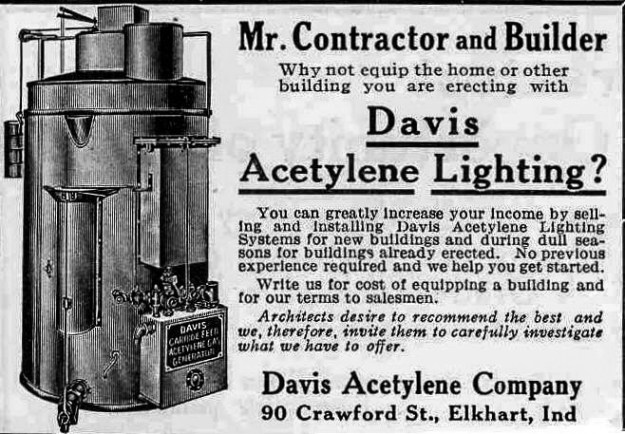
In the short period of time between kerosene or oil lamps and electricity, many cities, towns, and villages, hotels and businesses throughout America relied upon the often dangerous acetylene gas generator. Such also was the case for canal dredges and excavators running day and night, twenty-four hours a day. The generators mixed calcium carbide and water, generating acetylene gas for lighting dredging work at night.
The several agreements between the State Legislature and the canal company set out strict completion dates. In the last agreement calling for completion by 1912, dredges worked night and day in various places throughout the length of the Florida peninsula, including the incorrigible Matanzas-Halifax river cut, now in its 30th year of dredging in hard rock. In November 1912, the state trustees delivered to the Florida canal company the 12th and last deed to public land, totaling over one million acres for dredging 268 miles of inland waterway, later to comprise the Atlantic Intracoastal Waterway.
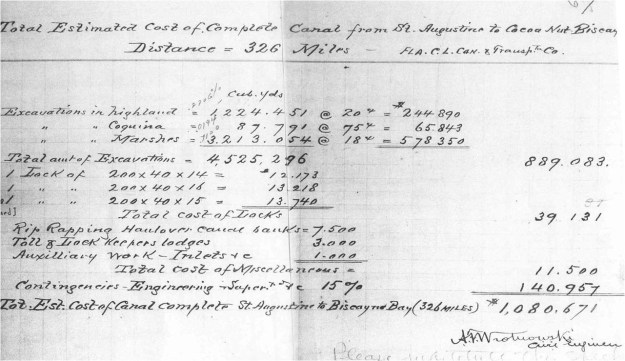
Estimated Cost of Completing the East Coast Canal from St. Augustine to Cocoa-Nut Grove, Fla. (1889)
Sometime in 1888, the Florida canal company engaged acclaimed Chicago-based railway and waterway engineer Elmer Lawrence Corthell to undertake a complete survey of the cost of the work to be done in completing what would become the Intracoastal Waterway from St. Augustine to Miami, Florida. In turn, Corthell retained Arthur F. Wrotnowski, an experienced civil engineer who had laid out the town of Clermont, Florida, to do the actual on-the-ground survey work.
Interestingly, Wrotnowski had been born in Clermont, France. Nine months later, in May 1889, Corthell reported to Florida canal company directors that 87% of the 326-mile distance consisted of watercourses, lagoons, estuaries, and sloughs, with the balance in dry land. For the most part, and this cannot be overemphasized, the waterways were less than 5 feet deep and largely non-navigable except for canoes and rafts. The State’s contract with the canal company called for a waterway not less than 5 feet deep throughout the entire distance of the waterway. In the case of the thirty-mile stretch of dry and muck land between the Matanzas and Halifax rivers (St. Augustine and Ormond Beach), the work would take thirty years. Corthell estimated the total cost at $1,080,671.00, including the cost of three locks, each 300 feet long.
North Carolina congressman John Humphrey Small, Intracoastal booster
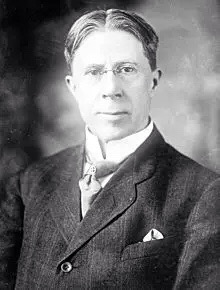
Within two weeks of Philadelphia congressman Joseph Hampton Moore (Rep.) filing a bill in March 1907 authorizing the Army Corps of Engineers to survey a route for an Intracoastal waterway from Maine south to Beaufort, N.C., North Carolina congressman John Humphrey Small (Dem.) filed a similar bill authorizing a survey from Beaufort, N.C., to Key West, Fla.
Consistent with Congress’s early historical view of the Constitution as a limiting document, constraining the powers of Congress to surveys only for internal improvements within the States, it would take two more decades for Congress to acquire the privately owned canals along the Atlantic coast, including the Chesapeake and Delaware Canal, the Chesapeake and Albemarle Canal, and the Florida East Coast Canal, as well as the Cape Cod Canal to the north of Norfolk, Va. In the case Florida, Florida was the only state required to purchase its own canal (the old Florida East Coast Canal) and turn it over to the federal government, free and clear, for future improvements, along with all necessary right-of-way and maintenance spoil areas for deposit of future dredged material from the conversion of the old Florida East Coast Canal tollway into the toll-free Intracoastal Waterway.
A continuous Atlantic Intracoastal Waterway from Trenton, N. J. to Miami, Fla., would not be fully completed by the Army Corps of Engineers until 1935, with the exception of a few incomplete miles in New Jersey.



 Florida’s Big Dig