I am Bill Crawford. I was born and raised in Ft. Lauderdale, Fla., bisected by the Intracoastal. I graduated from the University of Virginia with a bachelor’s degree in commerce, with distinction, concentrating in finance. I obtained my juris doctor degree from Stetson University College of Law. I have practiced law for more than 43 years. I am a professional historian and author of the award-winning book, “Florida’s Big Dig,” (2008) the story of the Atlantic Intracoastal Waterway.
I have practiced law in Florida since 1975. Along the way, I developed a keen interest in researching and writing history, publishing numerous scholarly journal articles and one award-winning book, “Florida’s Big Dig,” the story of Florida’s Atlantic Intracoastal Waterway, using my legal pbackground to understand legal transactions, deeds, wmortgages, bonds, preferred stock, and legal descriptions of land and water.
In recent years, I have maintained a limited practice consulting with other professionals on various historical land and water issues, including sovereign, riparian, and submerged land rights, focusing on the Atlantic Intracoastal Waterway and Florida inland waterways.
I maintain a broad regular website here at www.floridasbigdig.me and a website solely on how the book was researched as well as some of the major themes explored. The website on the book itself is at www.floridasbigdig.com.
The website on contacts for professional services is at www.floridasbigdiglawyer.com?. A fifteen-page outline of my book
Since we face heavy traffic every day, the waterways could be integrated with the existing road transport network. This system would greatly benefit the tourists and the locals. The various phases of the project are: 1. Documentation of existing river transport facilities. 2. Proposal for an overall inland waterway network. Suggesting new routes to add […]
Author’s Note: This is a creative enterprise system that integrates an inland waterways system with other transport systems in solving the dilemma of fast-growing populations in the Third World. But is this practical, useful and low cost over enough years to justify the upfront costs. Especially, when engineering fees and other soft costs grow at exponential rates. Generally unaccounted for in government projects, professionals may be required to provide professional errors and omissions policies. How large will the premiums on such policies be to cover the unknown risks and damages of new, untested systems that may be faulty or defective in the public sector?
The longest canal in France is the Canal du Midi. Here at Languedoc. Note the three canal boats on the left bank. All three are lined up with their bows pointing in the same direction. In the distance, an arch bridge for vehicles of all types. The sidewalk on the right could have been a towpath in the past when horses drew narrowboats or packet boat along canals all over the French country side.
This wrought iron pedestrian bridge in London is one of the highest foot bridges with the steepest slope over what looks to be a waterway used for canal boating.
In the distance, one can see a canal lock that appears to be in use. The bank on the right is heavily wooded and is probably a park. Considering the arc of the bridge, larger vessels than simple horse- drawn narrow-boats were in use on this watercourse when this bridge was designed for pedestrians.
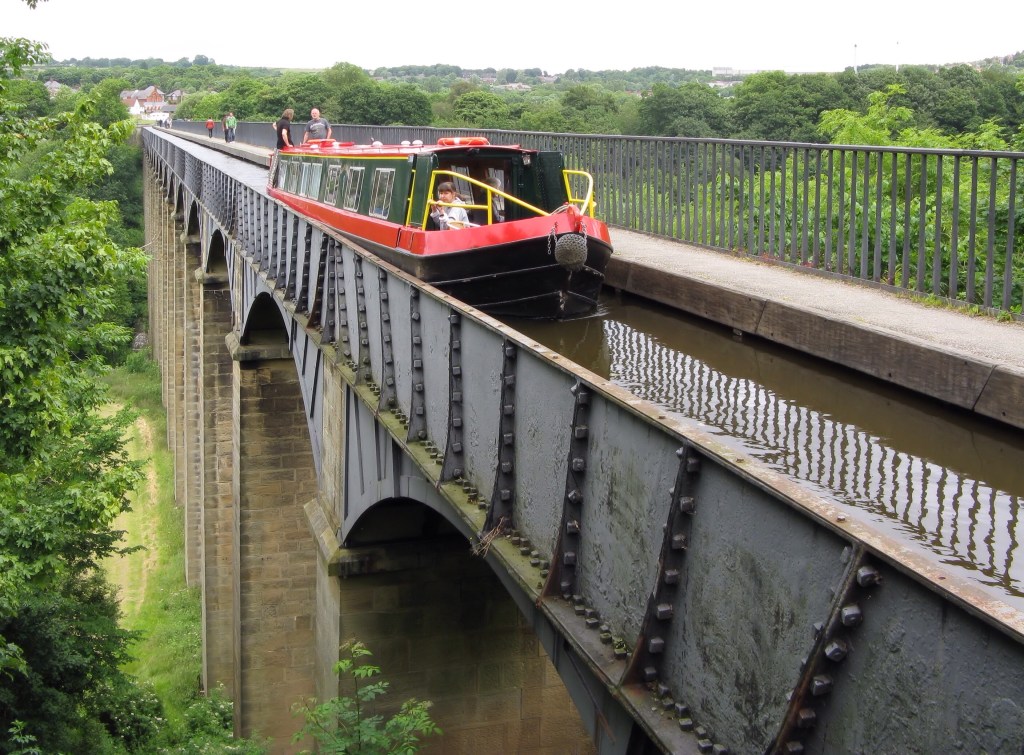
Designed by acclaimed bridge designer Thomas Telford, this metal transport aqueduct is 304 meters long and was completed in 1806.
Designed by acclaimed British bridge designer Thomas Telford, this metal transport aqueduct is 304 meters long and was completed in 1806. Before Telford began designing transport aqueducts in iron, aqueducts were constructed for centuries in brick and mortar. Brick construction, however, was not impervious to water leakage even though similar construction methods were used as far back as the Romans in building aqueducts for carrying water exclusively.
Today, this transport aqueduct is distinguished as a World Heritage site and known as Pontcysylite Aqueduct in Wales. Three hundred and four meters long, the aqueduct carries passengers in narrow boats over the Llangellen Canal over the River Dee Valley.
In the late 1790’s and early 1800’s, both the French and the British led the world in engineering. In the early 1800’s, President Thomas Jefferson established the United States Military Academy at West Point, the first engineering school in the nation. The choice was difficult but the Academy decided to follow the French methods in bridge and inland waterway construction. Accordingly, all of the early textbooks for the cadets were written in French!
Hon. Joseph Hampton Moore, mayor of Philadelphia, congressman, and founder of the Atlantic Deeper Waterways Association.
Unquestionably the ‘Father’ of the Atlantic Intracoastal Waterway, in 1907 Congressman J. Hampton Moore sponsored a bill to direct the Corps of Engineers to survey the Delaware River in his district for much needed deepening.
Bills dealing with such questions were referred to as Rivers and Harbors bills and were passed, generally, every few years instead of every year. These bills dealt with the rivers and harbors in a piece-meal fashion pitting one state or congressional district against another. Moore’s bill went down in flames, competing with bills from other states and districts with stronger congressional representation. In his first term in Congress, Moore could not understand why his bill, which sought only a survey for deepening, went down in defeat.
Moore devised a plan to stop governmental bureaucracy from pitting one state against another when a continuous inland waterway from Maine to Florida was needed. Moore called a meeting in Philadelphia in 1907 to form the Atlantic Deeper Waterways Association. Every Governor, Senator, House member, and interested Mayor from Maine to Florida was invited. It would be an ‘all for one’, and ‘one for all’ proposition calling upon Congress to appropriate $50 million a year for ten years.
Attendees would elect Moore president of the the ADWA for forty straight years until the job was done. A continuous protected inland waterway under federal control from Florida to Norfolk, Va., would not be completed until 1935, along with the Cape Cod Canal and other Atlantic coast inland waterways although not necessarily continuously protected by sufficiently large barrier islands, as in Florida.
Moore’s job had been accomplished. The ‘all for one’ plan worked. For much of the distance the inland waterway was at least 125 feet wide and at least 10 feet deep. Joined in the work was John Humphrey Small, a Member of Congress and for a time Chairman of the Rivers and Harbors Committee. More important, while Moore was a Philadelphia Republican, Small was a North Carolina Democrat. For years, the two formed an unbeatable combination in Congress on the question of an Intracoastal Waterway.
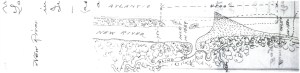
Between 1882 and 1889, the New River Inlet drifted almost a mile (4,500 ft.) as shown in this marginalmap made by A. F. Wrotnowski for a formal report ofsurvey submitted by Elmer Corthell to the Florida canal company.
Artur F. Wrotnowski, another civil engineer and graduate of West Point, performed the ground survey of the proposed Florida East Coast Canal (Intracoastal Waterway) for acclaimed Chicago railway and inland waterway engineer Elmer Corthell whom the Florida canal company had engaged to render the final survey in 1888.
In examining the work that lay ahead, Wrotnowski noted that from 1882 to 1889 the New River Inlet in Fort Lauderdale had moved almost a mile (4,500 feet) north along the Florida coast line. The New River Inlet was a natural inlet that until the Hurricane of 1947 existed across from today’s Bahia Mar Yachting Center (then, Coast Guard Station 6). Littoral (shore) drift is a natural process along the coast called Atlantic littoral drift that closes an inlet by the shifting of sand by complex current movements and sometimes opens another south or north of the original inlet. Here, the inlet shifted north because the currents pushed the sand south, as shown in the marginal map.
Inlets were considered beneficial because the influx of sea water into a inland waterway ordinarily kills off natural fresh water plants that often choked off a waterway. The problem, however, was how to deal with the constant movement of inlets along the Atlantic coast.
Many inlets were artificially made, as in the case of the Lake Worth Inlet; others were natural, like the Hillsboro Inlet that has existed in one location and hadn’t moved for hundreds of years, according to ancient maps of the Florida coastline.
First known dredge machine used in the Matanzas-Halifax River Cut (1882?). Courtesy, St. Augustine Historical Society.
The first dredge used in constructing the Intracoastal Waterway was a crude steel bucket dredge. Each bucket was the size of two average-sized men standing inside. The buckets were attached to a continuous steel chain, powered by steam. First used in the so-called Matanzas-Halifax Cut, the dredge was to join the Matanzas River at St. Augustine with the Halifax River at Ormond (now, Ormond Beach). The thirty-mile stretch of dry land required thirty years to complete the work. The constant breaking of the continuous chain as well as the tearing away of buckets from the chain made the work difficult to sustain.
In the dredging of dry cuts like this one, it was necessary to put fifty to eighty men with shovels and picks ahead of the bucket dredge to break up the solid ground and remove any sizeable trees. Often, expediency required a source of water ahead of the the work to make the rock and sand more easily removed by the buckets without sand and rock escaping the buckets.
It didn’t take canal company officials long to realize that more efficient machines were needed. The dredge machine was all encompassing. It contained not only the dredge itself but also sleeping quarters for the men operating the machine, a kitchen and dining area, as well as an acetylene gas generator for lighting, for dredging twenty-four hours a day.
Middle River looking west toward the Florida East Coast Railway tracks in the distancMiddle River looking west toward Flagler’s Florida East Coast Railroad. First railroad bridge built in 1896 as Flagler’s men moved like a juggernaut toward completion in Miami within just a few short months after the Florida East Coast Canal reached Miami. Courtesy, the author.
In 1892, U.S. Senator Duncan U. Fletcher (a strong backer of the Florida canal company) and others attempted to exploit a form of fiber called Ramie. Several Florida canal company officials became increasingly interested when an inventor obtained a patent on a decorticating machine that efficiently stripped useful fiber from the plant, yielding many times what previous machines had stripped from the plant. Ramie became useful in rope, sack, and heavy cloth making.
Fletcher’s group obtained the right to use the machine on an experimental basis and bought 1,300 acres of ramie lands along the Middle River north of the Town of Ft. Lauderdale from the Florida canal company.
For a while, the experiment yielded good results until Mexico heavily competed against the U.S. in the production of ramie. Consistently undercutting the U.S. in labor and production costs, production of ramie in the U.S, became a losing proposition. By 1912, Fletcher’s group had converted its agricultural lands into land development for housing, subdividing the land into scores of small lots in a subdivision called Progresso, north of the town of Ft. Lauderdale.
These small lots sold at auction attracted buyers from all over the country. So many prospective buyers arrived that buyers slept in scores of tents in an area north of the original Town of Fort Lauderdale colloquially called “tent city.” There was not even enough housing for the influx of prospective buyers of lots in the subdivision.
This aerial photograph looks westerly first over the Atlantic Ocean, then over the Lake Worth Inlet (sometimes called the Palm Beach Inlet)
The inlet bifurcates a long barrier island into two parts. The part on the left or the southern part constitutes the Town of Palm Beach. The part on the right or the northern part includes Riviera Beach and the John D. McArthur Park. Beyond the bifurcated barrier island and the Lake Worth Inlet is the Lake Worth reach of the Intracoastal Waterway. The island in the middle is called Peanut Island.
Lake Worth Inlet between the Atlantic Ocean (near) and the Intracoastal Waterway beyond the first barrier island.
During the Cuban Missile Crisis in 1962, the military built a bunker on Peanut Island for the protection of President John F. Kennedy, who vacationed in the family home on Palm Beach. Today, the site has been transformed into a park-like setting where families may picnic on the Island and visit the bunker. At low tide, boaters anchor about the Island, relaxing and enjoying themselves. Often at low tide, adults and children disembark their boats and wander about on foot.
In the late 1890’s, it was thought that inlets into the Intracoastal would serve a useful purpose in eliminating freshwater lilies and other fresh water plants from choking off several reaches in the Intracoastal where these plants grew more quickly.
The author rows a 21′ long ultra-lite Alden Star rowing shell the average person can lift and launch into the water. The oars are top-of-the-line oars hand carved from light wood in Vermont. A pair of oars will set you back about $400 but, in the opinion of the author, the cost is well worth it.
Author rows on the New River Sound (Intracoastal)
While more expensive than oars made from PVC, the slightly heavier weight lends more stability. And with experience, the combination of the ultra-lite shell propelled by the wooden oars create an experience that is just this side of heaven. The shell flat flies over water when the wind is down and the water flat.
Rowing on the New River Sound, or almost any tidally-influenced inland waterway, is a rough way to row. While I have rowed as fast as 10 knots in ideal conditions, those instances are few and far between. The best conditions are those found in flat water low or no wind such as lakes or closed non-tidally influenced water.
The New River Sound is a portion of the Intracoastal Waterway that runs from Lighthouse Point south through Fort Lauderdale to Hollywood, Fla.
The author took up rowing when age no longer accommodated running. I enjoyed running. But after discovering rowing, I’d say that rowing is a better conditioning experience with less stress on the feet, ankles, and knees. One caveat: talk to your physician before undertaking any exercise regime and find the right one for you.





 Florida’s Big Dig