Florida’s Big Dig

The story of the Intracoastal and other thoughts on water, waterways, land, and ecology

  • Whenever a dispute arises between or among the States of the United States of America, the U. S. Constitution provides that original jurisdiction lies in the Supreme Court.  In simple terms, whenever a dispute arises between or among the States, a State must file its lawsuit exclusively in the Supreme Court and not in any of the inferior federal courts or in any state court. art. III, section 2, Constitution.

    Legend Map of the Apalachicola-Chatahoochee-Flint River Basin
    Legend Map of the Apalachicola-Chatahoochee-Flint River Basin

    In the early years of the Republic, many of the disputes were questions over the boundary lines separating one state from another. State of Florida v. State of Georgia, 58 U.S. 478 (1855).  Such disputes begin with one State requesting permission to bring a lawsuit before the high court, together with a memorandum arguing the basis for bringing the lawsuit against another state or states.  The Court then appoints an attorney licensed to practice before the Court but residing in another State not involved in or affected by the lawsuit to serve as a special magistrate.

    The order appointing the special magistrate generally empowers him or her to take and receive evidence from the parties, issue subpoenas on request of the parties, conduct hearings as required, and to submit to the Court a report or reports and recommendations. The parties may then file exceptions or objections to a report.  The Supreme Court makes the final decision from which there is no further appeal.

    In later years, the population of the United States has grown to more than three hundred million.  Population growth in both Florida and Georgia has placed great demands on what is inevitably  a limited water supply.  Disputes between and among the States over this limited water supply have become intractable as demands on water supplies increase.  Complaining States seek intervention of the Court when at least one State believes that another State has used more water than equity allows.

    In 2014,  the State of Florida sued the State of Georgia, contending that Georgia has by overuse and impounding of water not yet needed deprived the Apalachicola Bay of sufficient water to sustain Florida’s oyster resource industry.  Florida alleges that an entire way of life dependent on oyster cultivation and an entire ecosystem supported by the Bay are already in jeopardy and may ultimately be destroyed.  See, 1992 cases State of Florida v. State of Alabama v. State of Georgia and, most recently, State of Florida v. State of Georgia, 2014.

  • Newzar's avatarNewzar

    Polish Waters Polish Waters

    Poland’s inland waterways are underexploited and underdeveloped. They barely account for 0.2% of the country’s total inland transport. In comparison, the proportion is 17% in Germany. The global trend is to promote water transport. Meanwhile, only 10% of Polish waterways have the operability parameters required by the 2002 resolution on the classification of inland waterways. Although the authorities admit that Poland needs to do a great deal in this area, two ministries seem to be acting at cross-purposes. The Ministry of Infrastructure and Development intends to allocate PLN 4 billion to enhance the navigability of Polish rivers. The plans may, however, be thwarted by the Environment Ministry whose draft water bill envisages a considerable rise in charges for water transport of goods and passengers as well as for the use of sluices. As a result, river transport might prove significantly more expensive than that by motorway. The ministry…

    View original post 208 more words

  • Franklin Lock and Dam on the Caloosahatchee River at Olga, Fla., opened in 1965, fourteen feet high, upstream of the Gulf Intracoastal Waterway, and built at a cost of $3.8 million.
    Franklin Lock and Dam on the Caloosahatchee River at Olga, Fla., opened in 1965, fourteen feet high, upstream of the Gulf Intracoastal Waterway, and built at a cost of $3.8 million.


    Kerr Lake is located in the Ocala National Forest, the largest concentration of sand pine in the world.  Home to black bear, bald eagle, and Florida manatee.
    Kerr Lake is located in the Ocala National Forest, the largest concentration of sand pine in the world. Home to black bear, bald eagle, and Florida manatee.
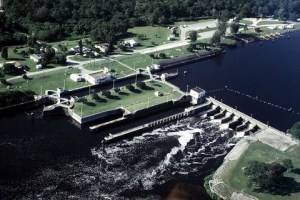
    St. Lucie Lock and Dam, Gateway to the Gulf of Mexico from the Atlantic Intracoastal Waterway
    St. Lucie Lock and Dam, Gateway to the Gulf of Mexico from the Atlantic Intracoastal Waterway
    Construction began on the Jim Woodruff Dam in about 1947 and opened in 1957. Located in Gadsden and Jackson counties, Florida/Decatur County, Georgia.  Impounds from the Caloosahatchee and Flint rivers created Lake Seminole (Reservoir), encompassing 58 square miles.
    Construction began on the Jim Woodruff Dam in about 1947 and opened in 1957. Located in Gadsden and Jackson counties, Florida/Decatur County, Georgia. Impounds from the Caloosahatchee and Flint rivers created Lake Seminole (Reservoir), encompassing 58 square miles.
  • The Masters. 16th hole. I couldn’t resist republishing this beautiful Azalea. Watercolor? I leave that decision to my readers.

  • Federal law requires the Secretary of the Army to make a physical inspection of the Atlantic Intracoastal Waterway at least annually and report his or her findings to Congress.

    Atlantic Intracoastal Waterway
    Atlantic Intracoastal Waterway

    The author has attended at least six inspections of the Florida portion of the Atlantic Intracoastal Waterway.  One of the more esoteric briefings was the replacement of mangrove shoots in the fast-moving current of the Jupiter Inlet at Jupiter, Florida, in Palm Beach County.  Engineers had devised a method of inserting hundreds of young mangrove shoots encased in PVC piping in the Inlet.  Several years later, we observed that these shoots had taken hold in the inlet and that they appeared to be thriving.

    Other briefings have included plans on restoring the original flows of the Everglades south to the tip of the Florida peninsula, as well as the installation of recreational areas, including a natural aquatic pool for the observation of marine life on Peanut Island at Lake Worth (Palm Beach) Inlet in the Waterway and cleanup of the bottom land of the Miami River utilizing performance specifications requiring the bidder to provide both the price and the method to be used in cleanup.

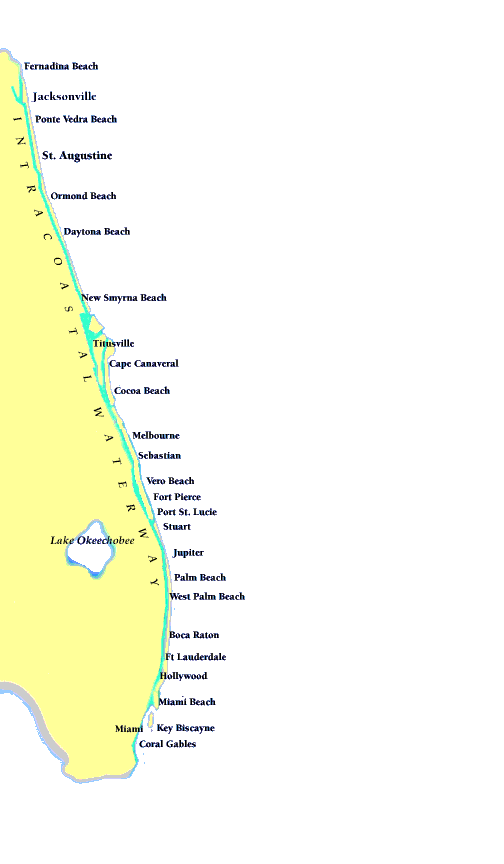
  • MAP OF THE EAST COAST OF FLORIDA

    Map of the East Coast of Florida
    Map of the East Coast of Florida
  • In the short period of time between kerosene or oil lamps and electricity, many cities, towns, and villages, hotels and  businesses throughout America relied upon the often dangerous acetylene gas generator.  Such also was the case for canal dredges and excavators running day and night, twenty-four hours a day.  The generators mixed calcium carbide and […]

    https://floridasbigdig.wordpress.com/2015/01/04/commercial-acetylene-gas-generator-ca-1905/

  • The Great Irish Waterway Renaissance parallels the tremendous interest in and expansion of the inland waterway of America, beginning with the building of the Erie Canal from 1817-1825 in New York,creating a direct link between New York City and the Great Lakes.  While the railroad rendered obsolete the inland waterways in America for the most part, seven great Irish inland waterways still exist along with a network of smaller canals in Ireland.  Ranked by length, the seven longest rivers are the River Shannon, 224 miles; the River Liffey; the River Lee; the River Swilly; the River Foyle; the River Lagan; and, the River Erne.

    The video is a trip traversing the great canals still in use in Ireland while few great canals remain in America, a land still in a rush to go nowhere in particular as long as one has an iPhone and a cup of Starbuck’s coffee.  Enjoy the slow travel of the canal, put away your iPhone, and avoid the distractions of everyday life.


  • Invasive water plants like the water hyacinth nearly enveloping the water course for a steamer in the St. Johns River in the ca. 1890's.
    Invasive water plants like the water hyacinth nearly enveloping the water course for a steamer in the St. Johns River in the ca. 1890’s.i

    Reportedly, water hyacinths were introduced into the waters of the St. Johns River and the Ocklawaha River as early as the 1880s.  The history of the growth of invasive aquatic plants has paralleled the growth in the use of steamboats in these waters. By the turn of the century, the invasion of these plants interfered with steamboat traffic.  Dense hyacinth growth interfered with docking at Palatka and dense mats of plant growth pushed flat bottomed steamers off course in Lake George.

    In 1899, Congress authorized the Corps of Engineers to eliminate plant obstructions in the navigable waters of the southeastern United States.  While the railroad replaced the steamboat as the primary mode of travel in Florida by the 1920’s, the growth of invasive plant species continued to choke off navigable waters throughout Florida, reduced biodiversity, deprived the waters of oxygen, killed off fish and other aquatic life, and disrupted ecosystems dependent on the growth of the smallest living animals for food.

    Methods of removing water hyacinths and other invasive plant species included a wide variety of mechanical means like large cutters and choppers and long draglines to pull large mats of plants from the surface of navigable waters.  Courtesy, IFAS, University of Florida.


  • From Lawrence, Kansas (PRWEB) September 14, 2009:

    When a hurricane roars inland, most low-lying coastal states rely on a network of pumps and canals to dissipate the storm surge and protect both lives and property. But add invasive plants and weeds to the mix, and you have a recipe for a disaster. Overgrown vegetation can wreak havoc and promote

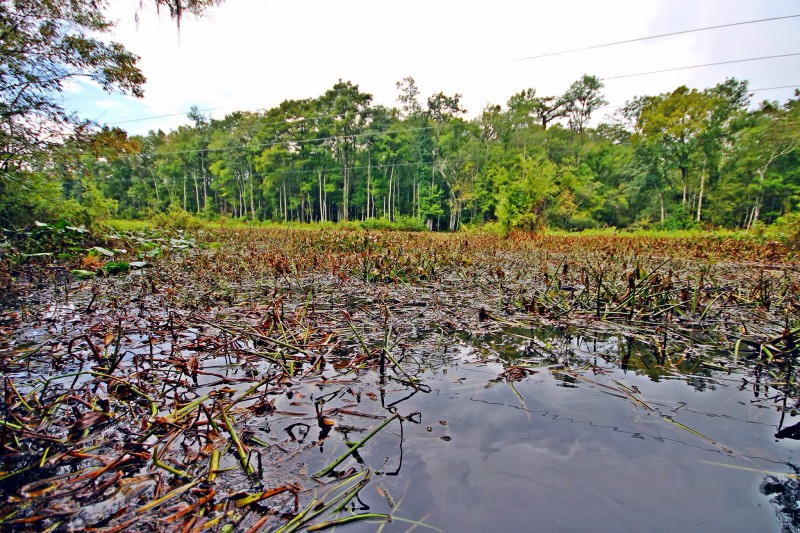
    Water plants choking waterway in Florida, impeding healthy water flow.  Including the water hyacinth, for over a hundred and fifty years water plants have invaded healthy watercourses, impeded transportation and disrupted healthy water flows and exchanges of nutrients, eventually smothering the watercourses invaded.
    Water plants choking waterway in Florida, impeding healthy water flow. Including the water hyacinth, for over a hundred and fifty years water plants have invaded healthy watercourses, impeded transportation and disrupted healthy water flows and exchanges of nutrients, eventually smothering the watercourses invaded.u

    flooding by jamming pumps and blocking water flow.

    According to the Weed Science Society of America, common culprits include floating water hyacinth (Eichhornia crassipes), water lettuce (Pistia stratiotes), submersed hydrilla (Hydrilla verticillata) and other fast-growing water plants.

    The problem is especially pervasive in Florida, where public lakes are connected by creeks, rivers or constructed canals that ultimately lead to the Gulf of Mexico or the Atlantic Ocean. Some of the largest pumps in the world are used to manage storm runoff and keep the surrounding areas from flooding. 

    “Invasive plants tend to coalesce at flood control structures in lakes and canals and at bends in river channels,” says Jeffrey Schardt, environmental administrator for invasive plant management with the Florida Fish and Wildlife Conservation Commission. “If left unmanaged, they can clog pumps, impede water flow and make flooding much, much worse. It’s imperative to have the overgrowth under control before a hurricane barrels inland.”

    Schardt says problems associated with invasive plants like water hyacinth and water lettuce reached crisis proportions along Florida’s waterways during the 1960s. But officials learned from that experience and have adopted routine maintenance controls to help prevent a recurrence. 

    We’ve found a single patch of water hyacinth can double in size in as little as two weeks during the growing season – forming large rafts that can be carried by wind and water currents, clog pumps and cause flooding,” Schardt says. “Time is not our friend, so we concentrate on frequent, small-scale control operations to prevent large-scale problems from developing.” 

    ———————-

    Florida law imposes strict penalties for  “introducing” invasive plants in Florida water courses.  Merely possessing these potentially destructive plants may lead to the imposition of fines or imprisonment or both.