I am Bill Crawford. I was born and raised in Ft. Lauderdale, Fla., bisected by the Intracoastal. I graduated from the University of Virginia with a bachelor’s degree in commerce, with distinction, concentrating in finance. I obtained my juris doctor degree from Stetson University College of Law. I have practiced law for more than 43 years. I am a professional historian and author of the award-winning book, “Florida’s Big Dig,” (2008) the story of the Atlantic Intracoastal Waterway.
I have practiced law in Florida since 1975. Along the way, I developed a keen interest in researching and writing history, publishing numerous scholarly journal articles and one award-winning book, “Florida’s Big Dig,” the story of Florida’s Atlantic Intracoastal Waterway, using my legal pbackground to understand legal transactions, deeds, wmortgages, bonds, preferred stock, and legal descriptions of land and water.
In recent years, I have maintained a limited practice consulting with other professionals on various historical land and water issues, including sovereign, riparian, and submerged land rights, focusing on the Atlantic Intracoastal Waterway and Florida inland waterways.
I maintain a broad regular website here at www.floridasbigdig.me and a website solely on how the book was researched as well as some of the major themes explored. The website on the book itself is at www.floridasbigdig.com.
The website on contacts for professional services is at www.floridasbigdiglawyer.com?. A fifteen-page outline of my book
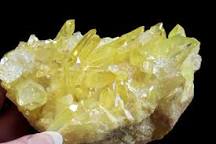
Yellow Quartz Crystal is a mineral which is found in many places throughout the Earth. It is not found in Florida where much of the geology is sedimentary. Quartz is a mineral in crystal formation born millions of years ago under the heat, pressure and hot gasses, often referred to as igneous. Igneous rocks are among the hardest of minerals found on the Earth’s surface. Quartz is found in many colors such as clear, yellows. blues, and greens
This map shows the various completion dates for the construction of dredged material management areas by the Florida Inland Navigation District (FIND).
Under an Act of Congress enacted in 1927, the federal government agreed to take over the privately-owned, old Florida East Coast Canal, substantially enlarge its width and depth, and perpetually maintain it, upon condition that the State of Florida buy the tollway from Palm Beach County developer Harry S. Kelsey, acquire all necessary rights- of-way or maintenance spoil areas (MSAs) for the deposit of all spoil areas needed by the Army Corps of Engineers, and identify a “local sponsor” to perform the State’s obligations.
Over the decades, natural mangrove plant islands built up within the boundaries of the Intracoastal Waterway (ICW). These should be distinguished from artificially constructed MSAs and identified by legal description in the public records of each county. In the case of MSA 684A, this maintenance spoil area is the northern forty feet of what is popularly (but incorrectly) known known as the Deerfield Island Park, maintained and within the north forty feet of what was popularly known as the the “Capone tract” or, much later, “Capone Island”.
It acquired the name largely because the notorious gangster Al Capone’s lawyer, Vincent Giblin, purchased the fifty-acre property, then a peninsula in 1929 “as trustee” for an unidentified beneficiary or beneficiaries before Capone went to prison for income tax evasion. The property became an island when Arthur Vining Davis (Arvida) bought the property and dredged the Royal Palm Canal between the ICW and the Hillsboro Canal in the early 1960s. The north forty feet of the Deerfield Island property lies within Palm Beach County and acts as a buffer between Broward County’s Deerfield Island Park and the posh Arvida development known as the Royal Palm Yacht and Country Club in Boca Raton in Palm Beach County.
Upon acquisition of the old private Waterway from Kelsey for $725,000, turnover of the waterway to the federal government, and the formation of FIND in 1929, the old waterway became the Florida link in the Atlantic Intracoastal Waterway, free of the burden of tolls and under the control of the federal government. Florida was the only state along the Atlantic seaboard required by Congress to purchase a waterway within its boundaries for turnover and enlargement by the federal government. The federal government used federal tax dollars to buy the inland waterways in the other states for the Atlantic Intracoastal Waterway.
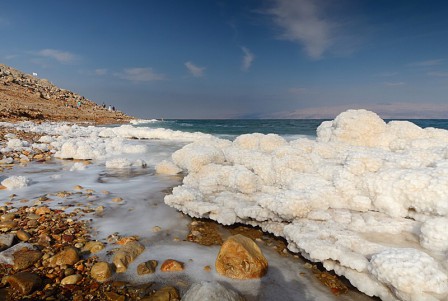
The Dead Sea is the lowest terrestrial geographical feature on Earth. The high percentage of salt in the Sea makes it the most buoyant water feature on Earth. The large amount of white froth on the sea shore depicted in this photograph shows the high concentration of salt in the Dead Sea. Some estimate salt concentrations as high as 30%.
Dead Sea beach with accumulated sea salt froth along the shoreline.
But why is the Dead Sea dying? The answer begins millions of year ago when shifting tectonic plates separated the continents. The Dead Sea has been 1,300 feet below sea level for millions of years. Until 1950, the process of the annual buildup of salinity has been offset by the infusion of fresh water from underground springs and aquifers.
Since 1950, real estate development, along with rising populations and demands for fresh water, have caused land surrounding the Dead Sea to become pock-marked with sinkholes swallowing buildings at an unpredictable rate. The Dead Sea itself has shrunk by a much as thirty miles measured along a north-south line.
Although one might think the answers ought to be easy given the oil-rich countries surrounding the Sea, the recent toppling of monarchies and dictatorships surrounding the Sea only make the possibility of a joint resolution among “countries” never really “nations” in the sense of United States, Britain, and France, even more difficult. Tribal wars among Muslims with different interpretations of Islamic traditions only recently have further reduced the chances for conciliation. The life or death of the “Dead Sea” hangs in the balance. The outcome is anyone’s guess.
Tap on the line above to enter the brochure. In my judgment based on my experience, this is the most exciting, decorative museum brochure I have ever seen. It is interactive. Touch an area like “Exhibitions” and the brochure goes to that page or any other page so that you can view the entire brochure detailing the re-opening of the Cooper Hewitt, National Design Museum. In recent years, this Museum has become one of more than a dozen museums under the aegis of the Smithsonian.
Several years since my essay on the life and work of Richard Schermerhorn, Jr., appeared in Shapingthe American Landscape, ed. Chas. Birnbaum (UVA Press 2008), I began receiving regular communications from the Cooper-Hewitt. I now know why. The newly released official history of the Museum includes the story of New York landscape architect Richard Schermerhorn, Jr.’s role in the design of the Terrace and Gardens. My work is cited in the book four times. The author attempted to speak with me, but, alas, my law practiced caused us to miss each other like ships passing in the night. If you type my full name in the brochure, it appears four times. I’m an incurable lawyer/academic. I am so pleased to have played but a small part in the Museum’s official history.
Although the Smithsonian has given the Cooper-Hewitt considerable cache over the years, federal financial support to underwright Museum operations has been eliminated. Today, the Cooper-Hewitt and other Smithsonian museums must rely on support from foundations, corporations, and individuals to pay operating expenses.
The Smithsonian began a hundred years ago when James Smithson, a British citizen who had never visited the United States left a considerable inheritance to America for Museum documenting America.
In 1901, the Andrew Carnegie House, terrace, and Gardens opened practically in ‘sticks’ at Fifth Avenue and between 91st and 92nd Streets in New York City. Andrew Carnegie and his family.
Years later, the House, Garden and Terrace became the Cooper-Hewitt/National Design Museum, a property of the Smithsonian Institution.
After years of planning and adhering as much as possible to the original designs and renovation the House as well as the Terrace and Gardens (now known as the Arthur Ross Terracce and Gardens). designed by Richard Schermerhorn, Jr., New York City landscape architect, engineer, and planner,.now awaits the official opening of the Museum. If you are interested, I encourage you to read the over-the-top brochure accompanying this posting. My biographical essay on the life and work of Schermerhorn was used in authoring the official history of the Museum.





 Florida’s Big Dig