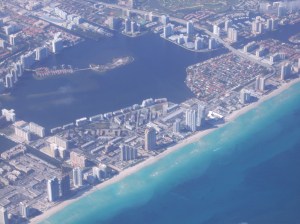
After federal takeover of the Intracoastal in 1929, the Florida Inland Navigation District (FIND) began the process of surveying the contour of the waterway as well as any other rights-of-way needed by the Army Corps of Engineers to deposit spoil to be removed in enlarging the width and depth of the waterway under the 1927 Act of Congress. Appointed by FIND to survey the waterway in the three southernmost counties was a very competent but salty-tongued Fort Lauderdale engineer, John Charlton.
If anything, John Charlton was punctilious about the precise spelling of the names of every geographic feature along the Florida waterway. When Charlton reviewed the spelling of the Dumfoundling Bay, he noticed there were two other variants in spelling the small bay leading to the larger Biscayne Bay.
Various maps going back to the early 1800s spelled the feature Dumbfounding Bay and Dumbfoundling Bay as well as the Dumfoundling Bay. Fortunately, Congress established a Board of Geographic Names to hold hearings, receive evidence, and make the final decision on spelling geographic features throughout the United States where such features had conflicts in naming.
Charlton submitted numerous maps, supporting material, even a sarcastic poem justifying the historical usage on maps for hundreds of years past naming the feature “Dumfoundling Bay.” After all, Charlton observed, naming the feature “Dumbfoundling Bay would result in naming it a “speechless orphan.”
In 1932, the U.S. Board of Geographic Names put the matter to rest, finally siding with Charlton and with the less controversial “Dumfoundling Bay.” Although one may see it spelled differently today in sloppy media, the correct and official name has already been decided otherwise by the governmental board whose job it is to decide these questions to insure uniformity in the naming of features on maps and thus prevent confusion.
Confused?

 Florida’s Big Dig
Leave a reply to Florida’s Big Dig Cancel reply