Florida’s Big Dig

The story of the Intracoastal and other thoughts on water, waterways, land, and ecology

  • Bucket, continuous-type dredge in the Matanzas-Halifax Cut
    Bucket, continuous-type dredge in the Matanzas-Halifax Cut

    In 1882, the Florida Coast Line Canal & Transportation Company (“the Florida canal company”) began dredging the difficult dry cut between the Matanzas and Halifax rivers using bucket, continuous chain dredges. The Florida canal company would not complete the work until 1912, thirty years later. For dredging what would become the Intracoastal Waterway from Jacksonville to Miami, the company would earn over one million acres of state land for dredging 268 miles of waterway and the right to collect tolls from waterway traffic. Courtesy, St. Augustine Historical Society.
  • 20130908-171344.jpg

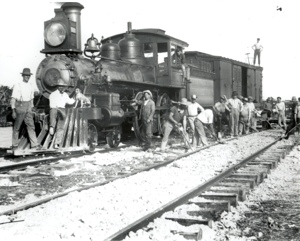
    Double-tracking the Florida East Coast Railroad signaled the end of commercial waterborne traffic along Florida’s east coast and the end of its only competitor in the 1920’s, the privately owned Florida East Coast Canal, later transferred to the Federal government in 1929 for conversion into the modern, toll-free Atlantic Intracoastal Waterway.

  • 20130908-171101.jpg

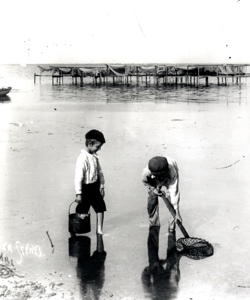
    Young barefooted boys digging for clams along the western sandy shore of the Indian River ca. 1900, with a long dock draped in nets in the background.  Courtesy, collection of the author.

  • image

    Young men after a day of fishing in the Indian River in the early 1900’s near Titusville, Florida. The Indian River is today often referred to as a lagoon. It has no origin or mouth and few characteristics of what we commonly call a river. Some, however, refer to the Indian River as part of the Indian River Lagoon system. It is broad and shallow like much of the southern parts of today’s Atlantic Intracoastal Waterway. In the 1880s only flat-botttom steamers could navigate parts of the River dredged by the Florida canal company as early as the mid-1880s to a depth of 5 feet and marked for navigation. Some stretches are as wide as 4 miles; others like the Indian River Narrows barely permitted the narrowest of small tourist steamers to navigate the southern reaches of the waterway.
    Courtesy, Collection of the author.

  • While the Florida canal company dredged what would become the Intracoastal Waterway, company directors in 1896 organized the Indian River and Bay Biscayne Inland Navigation Company to run steamboats on navigable portions of the waterway. One such steamboat was the “Saint Lucie” depicted here.</

    In 1898, the steamboat affiliate won the contract to ship munitions and mortars down the lower east coast waterway, still in poor condition, to Havana for the Spanish-American War in Cuba.

  • Owned by Commodore Avylen Harcourt Brook, the sloop Klyo “rescued” President-elect Warren G. Harding (in white pants, waving the hat) when the houseboat in which he had cruised hit a “snag” on the poorly maintained–and privately owned–Florida East Coast Canal (after 1929, the Intracoastal Waterway) at Fort Lauderdale in 1921. Born in Sheffield, England, in 1866, Brook retired at the age of 53 from a lucrative career in outdoor advertising to sleepy Fort Lauderdale in 1919. The short, stocky executive with a blonde ‘handlebar’ mustache acquired the title “commodore” from his association with several yacht clubs on Long Island Sound. An avid waterway enthusiast, Brook fought for a federal takeover of the Cape Cod Canal owned by August Belmont, who had constructed the waterway and charged tolls. In Florida, Brook would fight for a federal takeover of the Florida East Coast Canal and its conversion into the modern, toll-free Intracoastal Waterway from Jacksonville to Miami. 20130904-173446.jpg

  • Dipper dredge in the cut near Delray Beach

    Dipper dredge in a difficult “dry” cut near Delray Beach. The dipper dredge used an A-frame for stability. Long posts on the corners were driven into the bottom of what appears to be shallow water. The dipper scooped up the bottom consisting of soil and rock, depositing the spoil on either side and building up high banks. Attached to the A-frame the dipper could swing to either side. Dredges often ran 24 hours a day, lit by lamps burning acetylene gas (a combination of calcium carbide and water, but often an explosive one). Accounts indicate that dredge workers ate well, supplied with Chicago beef in Florida’s wild terrain. Native fare would have been wild turkey, fish, and vegetables). Settlers in what were the settlements of Delray and Boynton included farmers from Michigan led by promoters William Seelye Linton and Major Nathan Boynton. Courtesy, State Archives of Florida, Tallahassee, Fla. </

  • image

    One of the older steamboats plying the waters of what was then called the Florida East Coast Canal, the “Courtney” carried mostly passengers on short trips along the Florida East Coast in the 1890’s. Henry Flagler, then president of both the Florida East Coast Railway and the Florida canal company, cruised into Miami on the “Courtney” (also called the “Sweeney”) just before he arrived in Miami in one of his FEC Railway cars on April 13, 1896. Upon completion of the railway,Flagler liquidated his holdings in the Florida canal company and resigned as president. For the next thirty years, the Florida canal company and Flagler’s Florida East Coast Railway would compete for passengers and freight in providing transportation down the east coast of Florida. And both companies would compete for settlers buying the millions of acres of state land the Florida legislature promised these two companies for extending transportation into the southern tip of the Florida peninsula.

  • A narrow steamer carrying tourists in the Jupiter Narrows section of what was then called the Florida East Coast Canal (now, Intracoastal Waterway), as the Indian River narrowed down into Lake Worth. In some stretches of the Narrows, steamers of ordinary width stopped and started their way through a brush-lined privately owned tollway in the early 1900s. Courtesy, State Archives of Florida, Tallahassee, Fla.

    20130902-152815.jpg