
Harbor surrounded by townhouses, retail shops, and a yacht club along with slips for boats of every size in Sea Island Plantation, the largest plantation community on Hilton Head Island.
The story of the Intracoastal and other thoughts on water, waterways, land, and ecology
Harbor surrounded by townhouses, retail shops, and a yacht club along with slips for boats of every size in Sea Island Plantation, the largest plantation community on Hilton Head Island.

Harbortown Lighthouse at Sea Pines Plantation overlooking Calibogue Sound, a link through South Carolina and part of the Atlantic Intracoastal Waterway. Many sections in this area are quite shallow as a result of the failure of Congress to adequately fund the dredging of the waterway. By contrast, Florida legislators enacted the Florida Inland Navigation District in 1927 to collect property taxes from east coast county property owners to fund a portion of the maintenance costs.

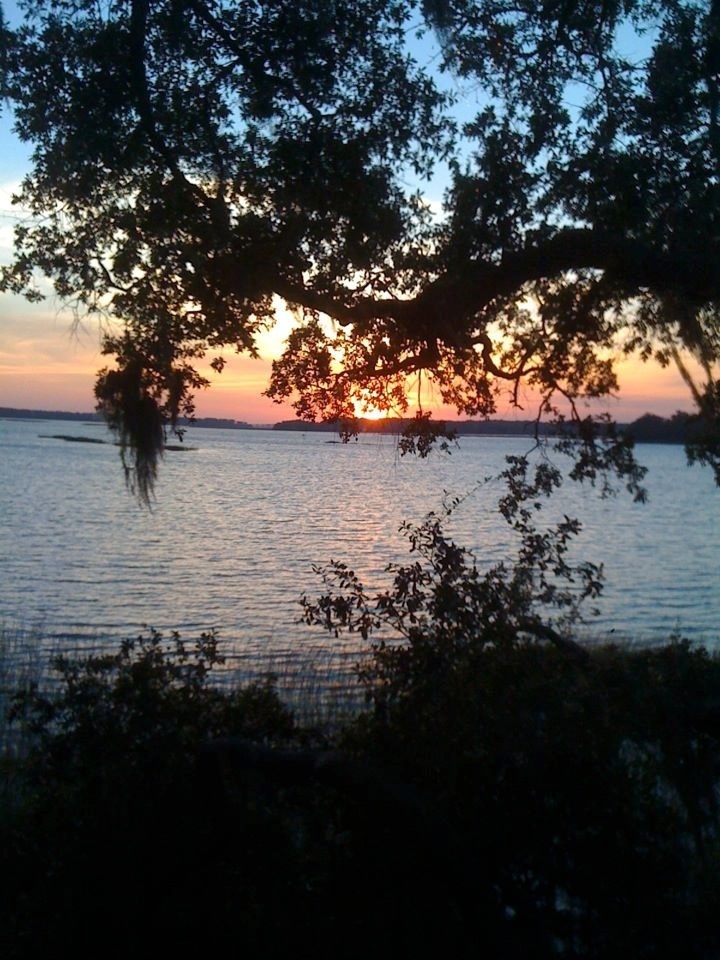
It was about 5:30 p.m. one day in the latter part of May several years ago. My wife was shopping while I was sitting down on the grass enjoying the cool weather. I checked for messages on my iPhone and took this photo. I have not changed the photo in any manner.

1889 sketch of Lake Boca Raton by civil engineer Arthur Wrotnowski’s illustrating a survey for the construction of an inland waterway from St. Augustine to ‘Cocoa-nut Grove’, Fla., made by Chicago railway and inland waterway engineer Elmer C. Corthell. The survey was made to induce George Bradley and other wealthy investors to join in the enterprise. Courtesy, Hay Library, Brown University, Providence, RI.

Group of Road Scholars on tour of the Intracoastal Waterway in Fort Lauderdale led by Lawyer/Historian Bill Crawford. To amplify voice and screen out boat noise, I wore a head set and a microphone while the ‘Scholars’ wore adjustable ear buds to increase/decrease sound as needed.
In the distance is the relatively recent E. Clay Shaw, Jr. Bridge, named in honor of the area’s longtime congressman who recently passed away. Clay was responsible for obtaining a significant amount of the funding needed for construction. Beyond the bridge lies Port Everglades, one of the busiest passenger cruise line ports on the Atlantic coast, opened in 1927. Courtesy, Claire M. Crawford.

Brigadier General Quincy Adams Gillmore, Second Florida chief of the Army Corps of Engineers. Gillmore graduated first in his class at West Point. He conducted several surveys of the Florida east coast during his command (1869-1884). In later years, Gillmore published several textbooks, including one on underwater concrete, a necessity in waterway and canal improvements. Gillmore recommended improvements in the old Haulover Cut that Wright had constructed in 1854. But Wright, now Gillmore’s superior and Chief of the Corps of Engineers, turned Gillmore down. The Federal Government remained resistant in spending federal dollars for construction of internal improvements. Construction of waterways was left to the states and to private enterprise for work deemed local in importance. In the relatively new state of Florida, its government after the Civil War was bereft of any cash to pay for public improvements. It was again left to private enterprise to finance canals and railways.
In 1881, four St. Augustine investors led by Dr. John Westcott, who also had been Surveyor General of Florida, formed the Florida canal company that would dredge 268 miles of privately-owned waterway by 1912 and earn the company more than a million acres of valuable east coast land from St. Augustine to the tip of the Florida peninsula as well as the right to collect tolls from waterway traffic. Westcott proved invaluable in heading the company. His knowledge of the choice state land available to pay for the company’s work benefitted the enterprise immensely in the years ahead. In 1929, the State of Florida turned over what been the private Florida East Coast Canal to the Federal Government free of charge for perpetual maintenance and enlargement as the Florida portion of the toll-free Atlantic Intracoastal Waterway. Courtesy, U.S. Army Corps of Engineers.
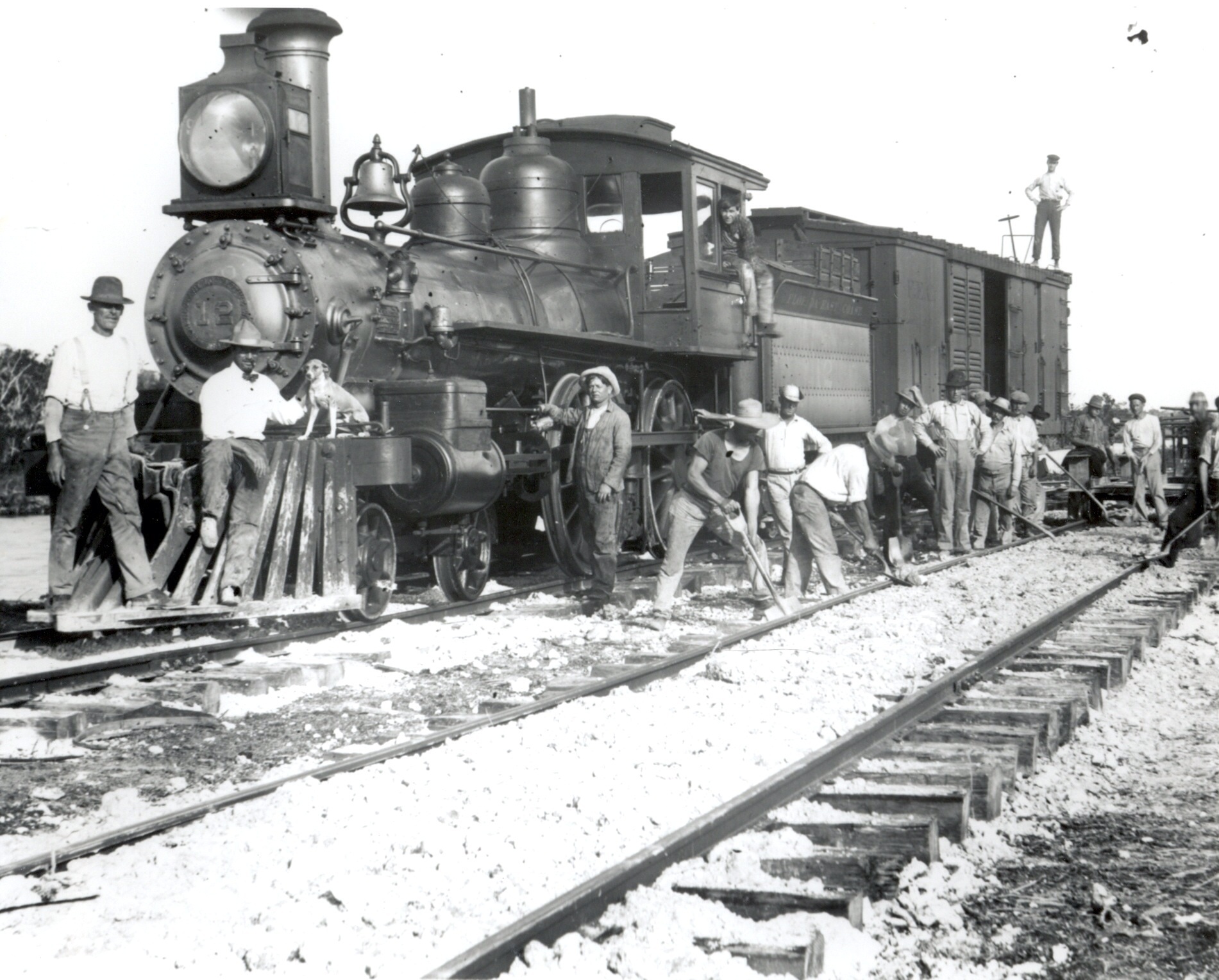
The completion and operation of the Flagler railway and other railways throughout Florida spelled the death knell for the Florida East Coast Canal and other inland waterways. At first, it was thought that inland waterways would serve as ‘rate-regulators’, competitors against a monopolistic railway system. As the railway system became more reliable and economical, many inland waterways simply could not compete against faster, more competitive railways in the delivery of most goods, especially perishables. The development of the Interstate Highway system beginning in the 1950s and the use of refrigerated trucking in tandem with containerized shipping soon overtook the competitive advantage of railways in the delivery of many categories of freight. At the same time, the development of the airplane and commercial jet aircraft took away much of the passenger traffic formerly transported by the railway. Courtesy, the author.

Bucket dredge in the Matanzas -Halifax rivers Cut south of St. Augustine ca. 1893. Large steel buckets attached to a continuous heavy chain scooped up sand, clay, and rocks, and then dumped the material on either side of the Cut via conveyor belts. Among the earliest of the dredges employed, the bucket dredge soon fell into disuse as chains often broke under the strain of conveying heavy spoil. Eighty to a hundred men with picks and shovels opened up ditches where little or no water existed. Courtesy. St. Augustine Historical Society.
For some time, there has been much debate over where the northern terminus of the Intracoastal Waterway (ICW) might be located. When I appeared as the “waterway expert” on the Modern Marvels documentary “Atlantic Intracoastal Waterway” shown on the History Channel, the writer/producer contended as many still do, that the AIW begins in Miami and ends in Boston. But as many point out, and I agree,the barrier islands along the Atlantic coast end in Virginia. And for the most part, there is open water north of Virginia,with some exceptions like the Cape Cod Canal.
In the early 1900’s, a new renaissance arose over federal support of inland waterways with the election of progressives like Theodore Roosevelt to the presidency and Napoleon Bonaparte Broward to the Florida gubernatorial post. More than thirty citizen’s groups lobbied Congress for inland waterway support. Among the most influential was the Atlantic Deeper Waterways Association (ADWA) led by Congressman Joseph Hampton Moore of Philadelphia. The ADWA had over 500 members, representing the coastal states from Maine to Florida when it first met in Philadelphia in 1907. The ADWA would spend the next three decades lobbying Congress for a continuous Atlantic Intracoastal Waterway, which would officially open in 1935 from Miami, Florida to Trenton, New Jersey. Courtesy, the author.
 1959 Gold Coast Marathon on the Intracoastal Waterway
Russell Fraser, Jr., racing an outboard motorboat in the 1959 Gold Coast Marathon on the Intracoastal Waterway between Miami and West Palm Beach and the return to Miami the next day. Some hydroplanes among the scores of boats of every class reached speeds approaching a hundred miles an hour. Many fast boats completed the two-day course at an average speed of sixty miles an hour. The brainchild of powerboat enthusiast Sam Griffith, the GCM ran from the Pelican Harbor Yacht Club at the 79th Street Causeway to WPB and back (134 miles) from 1947 through the 1960s. In later years, boat mishaps and injuries forced race committeemen to abandon the ICW for the modern Miami Marine Stadium, now in the hands of preservationists who hope to restore the abandoned stadium. Courtesy, Russell Fraser, Jr.
 Florida’s Big Dig