I am Bill Crawford. I was born and raised in Ft. Lauderdale, Fla., bisected by the Intracoastal. I graduated from the University of Virginia with a bachelor’s degree in commerce, with distinction, concentrating in finance. I obtained my juris doctor degree from Stetson University College of Law. I have practiced law for more than 43 years. I am a professional historian and author of the award-winning book, “Florida’s Big Dig,” (2008) the story of the Atlantic Intracoastal Waterway.
I have practiced law in Florida since 1975. Along the way, I developed a keen interest in researching and writing history, publishing numerous scholarly journal articles and one award-winning book, “Florida’s Big Dig,” the story of Florida’s Atlantic Intracoastal Waterway, using my legal pbackground to understand legal transactions, deeds, wmortgages, bonds, preferred stock, and legal descriptions of land and water.
In recent years, I have maintained a limited practice consulting with other professionals on various historical land and water issues, including sovereign, riparian, and submerged land rights, focusing on the Atlantic Intracoastal Waterway and Florida inland waterways.
I maintain a broad regular website here at www.floridasbigdig.me and a website solely on how the book was researched as well as some of the major themes explored. The website on the book itself is at www.floridasbigdig.com.
The website on contacts for professional services is at www.floridasbigdiglawyer.com?. A fifteen-page outline of my book
Short-statured Commodore Avylen Harcourt Brook ‘rescues’ President-elect Warren G. Harding aboard Brook’s 22-foot sloop “Klyo” after Harding’s houseboat cruising south on the New River Sound (now part of the Intracoastal Waterway) hits a snag “orchestrated” by Brook, the city’s unpaid public relations director, in 1921. Harding (white pants, waving his hat) annually took Florida cruises aboard houseboats furnished by politicians and friends. (Courtesy, Ft. Lauderdale Historical Society).
Whenever he was able, Harding played golf at the nine-hole Lauderdale golf links, a portion of today’s Fort Lauderdale-Hollywood International Airport, which during World War II was Naval Air Station – Ft. Lauderdale. The Station trained hundreds of pilots, bombers, and navigators, including the future U.S. President, George Herbert Walker Bush.
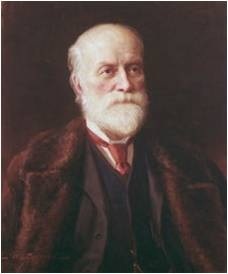
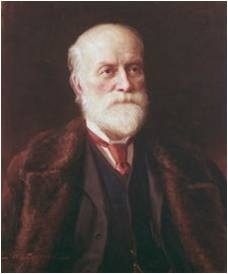
Sir Sandford Fleming, chief engineer of the Canadian Pacific Railway,
The Canadians are coming! The Canadians are coming! In the late 1880s, four Canadians, including Sir Sandford Fleming’s son, Sandford H. Fleming, traveled to the State of Florida to enter into a subcontract with the Florida canal company to perform a portion of the work in the Matanzas-Halifax River Cut joining St. Augustine and today’s Ormond Beach, just above Daytona Beach.
Sir Sandford Fleming had won world-wide acclaim as chief engineer of the Canadian Pacific Railway, the designer of Canada’s first adhesive postage stamp, and the inventor of the 24 time zones around the world known as Universal Time, making it easier for railways to create timetables for arrivals and destinations around the world.
The particulars of the early Florida work performed by the junior Fleming are to date unknown. We do know that after a time the Canadian group failed to complete the work, owing a substantial sum in damages to the Florida canal company. The Canadians wouldn’t be in a position to repay the debt until almost thirty years had passed.
Meanwhile, several officials of the Florida canal company and a Newburyport, Mass. banker, Albert P. Sawyer, formed the Boston and Florida Atlantic Coast Land Company to buy 100,000 acres of the Florida canal company’s state land grant at a dollar an acre for $100,000. Sawyer also created three land trusts to buy more canal company land, restoring the canal venture’s coffers to further dredging work down the Florida peninsula into the Indian River. Soon Sir Sandford Fleming became the largest stockholder in the Boston & Florida land company after company officials made the stock exchangeable in land owned by the company.
There are seventeen varieties of the croton plant in Florida and other areas with subtropical climates. The croton is generally salt tolerant and thrives in alkaline soils. Croton grows relatively slowly and requires little care and maintenance.
The purchase of the Cape Cod Canal built by August Belmont was authorized by the same Act of Congress in 1927 that authorized the Army Corps of Engineers to enlarge and perpetually maintain the Florida East Coast Canal. Like the Cape Cod Canal, the Florida East Coast Canal was privately owned and collected tolls from marine traffic transiting the waterway.
The difference was that Federal funds were used to buy the Cape Cod Canal and every other waterway along the Atlantic coast to create parts of what some called the Atlantic Intracoastal Waterway, with the exception of the Florida East Coast Canal. The State of Florida created a special taxing district along the Florida coast to issue bonds and buy the waterway for $725,000. No other state was required to turn over its inland waterways to the federal government, free of charge.
Dredge working the Matanzas River Inlet south of St. Augustine early 1900. Courtesy, Florida Photographic Collection, State Library of Florida, Tallahassee, Fla.
The “Swan” began as a flat-bottomed stern-wheel steamer hauling cotton on the Mississippi River. The was said to cruise so lightly upon the water, the “Swan” would float like a drop of dew in her transits up and down the River. In her second reincarnation, the “Swan” was purchased by the Indian River Steamboat Company to transport citrus and winter vegetables up and down the Indian River in the early 1890s. Allied with a railroad company, this steamboat company went bankrupt.
Several investors in the canal company organized another company that practically exhausted the English language in naming it to buy the “Swan” and other assets in 1896 or 1897 from the bankrupt company. The Indian River and Bay Biscayne Inland Navigation Company soon operated a small fleet of steamers along what would become Florida’s Atlantic Intracoastal Waterway. In 1898, the company won the contract to transport munitions down the waterway to Cuba for the short-lived Spanish American War.
Gregg Russell plays his guitar and sings folk and children’s songs to hundreds of young and old under one of the largest and oldest oak trees in Harbour Town, Sea Pines Plantation, Hilton Head Island. The Memorial Day concert has been free during the entire time of Gregg’s 26-year run. The youngest toddlers sit on the stage with Gregg, clapping their hands and singing some of their favorite songs, Memorial Day 2013.
Under the big Oak Tree at the Lighthouse Marina, Gregg Russell entertains young and old with family-style folk songs and folk tales.
Russell entertains old and young alike with children and folk songs under the gargantuan old Oak Tree in front of a string of small boutiques, clothing stores, and restaurants. It’s at Lighthouse Marina, in Sea Pines Plantation. The smallest children sit on the stage at Russell’s feet, often singing along with Russell. It’s nice to see entertainers who can entertain without resulting to vulgarities.
Chief engineer of the Canadian and Pacific Railway, Sir Sandford Fleming was also the designer of Canada’s first adhesive postage stamps. In 1892 Fleming and his son, Sandford H. Fleming, as well as several other Canadians became interested in the inland waterway being dredged along the east coast of Florida. In a matter of time, Sir Sandford became the largest investor in the affiliated Boston & Florida land company.
But by 1912, Fleming and his Canadian colleagues had become disenchanted with the enterprise. No dividends had yet been paid on their stock. In a few short years, the Fleming group would soon reap dividends as high as 16% annually on their investment after completion of the Florida waterway and the sales of lands abutting the waterway and Flagler’s railway.



 Florida’s Big Dig