Florida’s Big Dig

The story of the Intracoastal and other thoughts on water, waterways, land, and ecology

  • TAMPA BAY BUSINESS JOURNAL

    Government, business leaders urge capitalizing on canal expansion
    Oct 30, 2014, 2:47pm EDT

    Wade Millward
    Former Florida Senator George LeMieux listens to the business panel at a global trade symposium Thursday. LeMieux, now with the Gunster law firm, gave the event’s final presentation on the importance of global trade.

    Wade Millward
    Reporter-
    Tampa Bay Business Journal
    Email | Twitter | LinkedIn
    With more investment, Florida can lead the Western Hemisphere in global trade, speakers preached to audience members at a Thursday symposium.
    Two panels, one of government officials and a later one of trade and transport executives, highlighted conditions the state can use to capitalize on the finished $5.2 billion Panama Canal expansion next year.
    They touted expansion projects also happening in the state to ease transportation congestion and provide a skilled workforce.
    Tampa Bay Business Journal and Bank of America Merrill Lynch hosted the Tampa Bay Global Trade and Transportation Symposium at Port Tampa Bay.
    Speakers from both panels demanded audience members request more spending from the Legislature to increase the state’s reputation as an international hub and surpass states such as California and New York.
    “Somebody’s going to win this race,” moderator Tony Carvajal, who is Florida Chamber Foundation’s executive vice president, said at the panel’s close. “We’ve got to do this now.”
    The port is adding 25 acres and expanding to seven total docking cruise lines in time for cruise season starting Sunday, CEO Paul Anderson said. It’s in negotiations with manufacturers, including a handful from Latin America, to open in Tampa Bay.
    Tampa International Airport will finish an expansion by 2017 and is negotiating direct flights from Europe to encourage tourism and foreign companies to open local regional offices, CEO Joe Lopano said.
    The Florida Department of Transportation is widening Interstate 75 from the Georgia border to Alligator Alley to six lanes, assistant secretary Rich Biter said.
    Hillsborough County will open a small business center for entrepreneurs in two weeks, County Commissioner Sandra Murman said.
    “We will be the place where everybody wants to be,” the commissioner said.
    During the business panel, Bob O’Malley, CSX resident vice president of state government and community affairs, said CSX will hire a few thousand workers for upcoming projects and to replace retiring employees.
    CSX opened a distribution center in Winter Haven to act as statewide hub and broke ground on a 400,000-square-foot nearby space for retailers, O’Malley said.
    The lesson from the symposium should be the necessity of government creating business opportunities while companies deliver more trade, said panel moderator and Florida Chamber of Commerce global outreach director Alice Ancona.
    One recent success: Tampa International Airport recruiting Copa Airlines, which offers flights between Tampa and Panama City, Panama.
    “The partnership I’ve seen here is how we can together grow international trade,” said Fernando Fondevila, Copa Airlines regional commercial manager for North America.
    Wade Millward is a reporter for the Tampa Bay Business Journal.

  • Florida East Coast

    Will the railroad ‘close’ waterways in Florida?

    Date Reported: Oct 26, 2014

    Mile: 0.0

    Reported by: Mike Ahart, News Editor

    New-River-Bridge-BoatUS.jpgWe have posted several articles on the proposed rail service that would significantly affect navigation in Stuart and Fort Lauderdale, and for many in the Jupiter area, plus affect the ambiance and road traffic in some of our favorite cruising towns. We hope you have either attended the U.S. Coast Guard meetings or have posted your comments to the USCG – if you have not yet taken the USCG survey, you have only until November 1, 2014 to do so (See related Waterway Guide article: Voice your views on Florida railway bridge issue).

    BoatUS alerts us to a set of new public meetings, this time held by the U.S. Federal Railroad Administration. BoatUS has also set up its own survey on the issue – we urge you to take this survey as well, and try to attend one of these meetings:

    Under plans for a new passenger rail service along Florida’s Atlantic Coast from Miami to Orlando, waterway drawbridge closings along the proposed route would become more frequent. The new passenger rail service, known as All Aboard Florida, would offer hourly trains starting in the early morning and ending in the late evening, requiring additional bridge closings on waterways used by boaters in the nation’s #1 boating state. This includes the New River, Loxahatchee River and St. Lucie River. Up to 32 scheduled railroad drawbridge closings per day could last up to 25 minutes each.

    Boat Owners Association of The United States (BoatUS) urges boaters and anglers potentially affected by the proposal to have their voice heard at one of eight public meetings held by the US Federal Railroad Administration scheduled for October and November, or to provide their written comments to the U.S. Coast Guard by November 1.

    The US Federal Railroad Administration will hold the following public meetings:

    October 27, 2014, 3:30 PM – 7:00 PM
    Miami-Dade College – Wolfson Campus
    James K. Batten Room – 2106300 NE 2nd Avenue
    Miami, FL 33132 

    October 28, 2014, 3:30 PM – 7:00 PM
    Broward County Convention Center
    1950 Eisenhower Blvd.
    Fort Lauderdale, FL 33316 

    October 29, 2014, 3:30 PM – 7:00 PM
    West Palm Beach Marriott
    1001 Okeechobee Blvd.
    West Palm Beach, FL 33401

    October 30, 2014, 3:30 PM – 7:00 PM
    The Kane Center
    900 SE Salerno Road
    Stuart, FL 34997

    November 5, 2014, 3:30 PM – 7:00 PM
    Indian River State College – Richardson Hall
    6155 College Lane
    Vero Beach, FL 32966

    November 6, 2014, 3:30 PM – 7:00 PM
    Port St. Lucie Civic Center
    9221 SE Civic Center Place
    Port St Lucie, FL 34952

    November 12, 2014, 3:30 PM – 7:00 PM
    Cocoa Civic Center
    430 Delannoy Avenue
    Cocoa, FL 32922

    November 13, 2014, 3:30 PM – 7:00 PM
    Wyndham Orlando Resort
    800 International Drive
    Orlando, Florida, 32819

    To provide written comments on how these changes will impact your boating or fishing, go to BoatUS.com/allaboardsurvey, fill out the survey form and email to the address provided. The US Coast Guard is charged with ensuring safe and unobstructed passage for waterborne traffic while also considering the needs of other transportation modes. Comments to the USCG are due by November 1.

    For additional information, go to BoatUS.com/allaboardinfo.

    Learn more about the proposed train service:

    Source: BoatUS

  • Pres. Theodore Roosevelt operating what appears to be a dipper elevator dredge in the Culebra Cut in 1906,
    Pres. Theodore Roosevelt operating what appears to be an elevator dredge in the Culebra Cut in 1906.

    The Culebra Cut was the most difficult of all the dredging operations in the digging of the Panama Canal.  Capt. David Gaillard, of French Hugenot ancestry, was chief of dredging operations at the Cut and a cousin of Henry Gaillard.  Henry had been one of the four original incorporators of the Florida canal company, the longest serving director, and a St. Augustine state senator.  Henry’s political importance in securing the million acres of state land promised for dredging what would become the Intracoastal Waterway cannot be overstated.  Without Henry’s political clout after the death of Dr. John Westcott, it is doubtful the company would have been successful.

    The Culebra Cut was essentially a cut through a solid mountain.  So arduous was the work, including dynamiting and the building of a railway to remove the rock and debris, it left David a broken man.  David was hospitalized for the balance of the Panama Canal work.  He died before the opening ceremonies. Here, Roosevelt operates an elevator dredge, which required level ground and the laying of railway steel and wooden ties.  The Florida canal company used elevator dredges in the northern extension of the Florida waterway from St. Augustine to Jacksonville.  Courtesy, Library of Congress, American Memory.

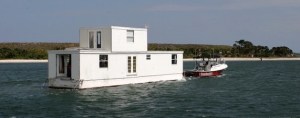
  • Lozman houseboat in transit.
    Lozman houseboat in transit.

    Several years ago, the City of Riviera Beach (“the City”) straddling the Intracoastal Waterway (ICW) in Florida, arrested a houseboat under federal maritime law and demolished it. The homeowner, Mr. Lozman had lived on his houseboat for more than a dozen years under a lease with the City. The City had sent Lozman several eviction notices for deficiencies in the houseboat and failure to make certain payments.

    The District Court of the Southern District of Florida found that the houseboat was a “vessel” for purposes of admiralty jurisdiction, that the vessel was delinquent in payments, put the vessel up for auction, the City bought it for the amount of its judgment and demolished it.

    The court held that the houseboat met the definition of a “vessel”within the meaning of 1 U.S.C. s. 3; accordingly, federal maritime law applied despite the fact that the houseboat had been an “indefinitely moored” structure. It was still “capable” of transportation.

    The Eleventh Circuit Court of Appeals agreed with the District Court’s holding that Lozman’s houseboat constituted a “vessel” for purposes of maritime jurisdiction and that Lozman’s houseboat “trespassed” upon city property.

    On January 15, 2013, the Supreme Court reversed. The Court held that Lozman’s houseboat was not a “vessel” for purposes of invoking maritime jurisdiction. Except for the fact that it floated upon the water, Lozman’s houseboat had no means of self-propulsion, no steering mechanism, an unraked hull, no means of storing or generating electricity, and no realistic means of transporting passengers or cargo.

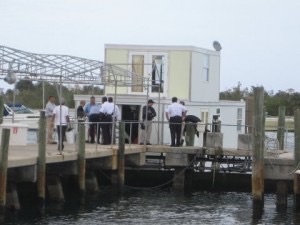
    Onlookers observe Lozman houseboat moored at Riviera Beach docks.
    Onlookers observe Lozman houseboat moored at Riviera Beach docks.

    Federal courts therefore have no jurisdiction over “houseboats” similarly configured and indefinitely moored. In general, federal courts have exclusive maritime jurisdiction over “vessels” like boats in navigable waters such as the Intracoastal Waterway. Although federal jurisdiction protects those who improve and work on boats by affording workers the right to arrest a vessel for unpaid work and enforce a lien for such charges as well as the right to seek damages for trespass on private property, asserting federal jurisdiction also brings into play the regulatory powers of the Coast Guard to insure public safety as well as other agencies working to protect the environment and other public interests.

  • First dredged in 1852, the Haulover Canal connected the Mosquito Lagoon and the Indiian River.
    First dredged in 1852, the Haulover Canal connected the Mosquito Lagoon and the Indiian River.

    In 1852, Lieutenant Horatio Governeur Wright led the the Corps of Engineers in the second inland waterway Renaissance.  Wright supervised the construction of the first Haulover Canal lined with wood, two feet deep and twelve feet wide at a cost established by Congress at $1,200. Although the amount seems minuscule today, it represented a breakthrough in Congressional thinking about the expenditure of federal funds for internal improvements. For a half a century, Congress authorized funds for surveying projects only but none for construction.

    The Haulover Canal, however, represented an exception. The U.S. Army had fought two costly wars against the Seminoles. Men, materiel, and munitions shipped on the Indian River had to be hauled by carts over this spit of land between two bodies of water. For the next 150 years, the “common defense” exception authorized numerous projects that at first seemed disqualified for construction funding. Congress also devised numerous ingenuous schemes to circumvent restraints such as when Congress authorized the purchase of stock in railroad companies to aid internal improvements.

  • St. Augustine’s anchoring and mooring pilot program tested | StAugustine.com.

    Under a state pilot program, St. Augustine enacted an ordinance requiring boats to moor at least fifty feet from the navigable channel of the Intracoastal Waterway. One man who has lived aboard his sailboat for eleven years filed suit challenging the law in federal court.

    Under federal maritime law, the federal government has the right to establish mooring rights within the Intracoastal Waterway and its tributaries. The federal supremacy clause makes federal law the supreme law of the land.

    Generally, regulation of the use of the Intracoastal Waterway depends upon whether or not the federal government has preempted state and local law by enacting federal law over various uses of the waterway. However, the State of Florida owns the bottom lands of the Waterway by right of sovereignty under federalism. Unless the federal government intervenes in various uses, local governments may set speed limits for marine vessels, for example, transiting the waterway.

    Court watchers await the final decision of the United States Supreme Court if the matter reaches that level of judicial authority. The author of this blog believes the federal government will prevail. In the absence of a uniform federal law on mooring, the author envisions scores of municipalities each with a confusing mishmash of differing mooring laws along the waterway.

  • REmbed from Getty Images

    The first inland waterway in America was the canal built at Ipswich, Mass., in 1636.  All other waterways were built with private or state funds through a variety of schemes, including the use of a lottery, for two centuries more until the 1850’s.  Constitutional constraints still prohibited Congress from financing canal construction. Still, Congress freely financed surveying projects throughout the country for national defense purposes.

    Eventually, reliance upon the Constitution’s ‘Commerce Clause’ emboldened Congress to engage in matching funds with the states and outright grants of smaller projects such as the minuscule Haulover Canal at Titusville in 1852 for a total of $1,200.

    Just before the outbreak of the Civil War, Congress begrudgingly bought stock in private canal stock companies and engaged in a number of indirect methods to assist canal companies just as the railroad came into wider use as a faster and more economical means of transporting fruits, vegetables and other perishables as well as iron ore, lumber, and oil.

  • Embed from Getty Images

    The construction of the wildly successful Erie Canal in the State of New York set off a new era of canal construction across America. For the first time, an inland waterway provided a connection between New York City on the Atlantic coast and cities along the shores of the Great Lakes like Chicago. The link allowed New York City to surpass Baltimore as the largest city in the United States.

    A strict construction of the Constitution rooted in the Constitutional Convention. at Philadelphia limited Congress’s powers to construct “post-roads” and undertake specific tasks set forth with particularity. Federal financing of inland waterways was not one of them. In fact, a bill to engraft the power to build inland waterways failed to pass in Philadelphia. The restraint against federal financing left New Yorkers with little choice but to build the Erie Canal with state and local funding as well as private financing and the implementation of tolls as a means of maintaining the Canal.

  • http://youtu.be/FpJz1wsF6Z8.

    The Chesapeake Bay is an estuary lying inland from the Atlantic Ocean surrounded by the states of Maryland and Virginia.  Encompassing over 4,479 square miles, it is the largest such body of water in the United States.  More than 150 rivers and streams flow into this estuary.

    The Bay has become environmentally challenged by the agricultural economies surrounding it.    Over the past several decades, run offs from chemicals used in farming have dramatically reduced oyster and crab populations and lost a generation of “watermen” whose livelihoods have depended on this food source for centuries.

    Click the underlined link above for a five-minute video of a tour of the Chesapeake Bay from the air.

  • imageAt the turn of the last century (1895-1920s), something of a renaissance occurred in the political will of the Nation in the demand for inland waterway transportation.  More than thirty citizens groups coalesced from all over the country to demand waterway construction to challenge not only the confiscatory tariffs charged by the railways but also to address the shortage of railway cars available to ship freight and carry passengers across the country.  Among these citizen groups were the National Rivers and Harbors Congress (NRHC) and the Atlantic Deeper Waterways Association (the ADWA), both of which formed in the early 1900’s.

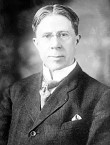
    A first-term Republican congressman representing Philadelphia, Joseph Hampton Moore sought funds to deepen a portion of the Delaware River.  His colleagues voted the bill down.  So resolute was Moore in finding some way to acquire these funds that he spearheaded the organization of the ADWA in Philadelphia in 1907.  Five hundred governors, congressman, other political leaders, as well as business leaders, and chamber of commerce representatives attended.  Instead of each state along the Atlantic seaboard separately applying for scarce funds under the Rivers and Harbors Act, Moore advocated a ‘one for all, all for one’ lobbying approach. No longer would states be pitted against each other by governmental bureaucracies distributing funds for improvements.  Within weeks, Moore introduced a bill in Congress to authorize the Corps of Engineers to survey a continuous inland waterway from Maine to Beaufort, N.C.

    North Carolina congressman John Humphrey Small, ardent supporter of the ADWA.
    North Carolina congressman John Humphrey Small, ardent supporter of the ADWA.

    A few days later, North Carolina Democratic Congressman John Humphrey Small introduced a bill to authorize the extension of the survey southward from Beaumont, N.C. to Key West, Fla.  It would take until 1935 for the federal government to acquire and enlarge the largely privately owned inland tollways into a continuous, federally controlled, toll-free Atlantic Intracoastal Waterway from Miami, Fla., to Trenton, N. J., with the exception of a few miles.

    The New Englanders and the bank administering Bradley’s estate finally saw a way out of the Florida waterway’s never-ending maintenance problems and the slow sale of Florida land.  They could sell the Florida East Coast Canal en masse to the federal government. It was only a matter of time.