Florida’s Big Dig

The story of the Intracoastal and other thoughts on water, waterways, land, and ecology

  • The 2014 boat show held in Dubai displayed more than 400 yachts and super yachts, including one of the longest super yacht in the world at 290 feet, from 50 different countries. The event attracted 26,000 visitors from 120 different countries. The United Arab Emirates is thought to be the 6th richest country by Gross National Product.

    The 2015 boat show will be held from March 3 through March 7, 2015.

  • geography lady's avatarThe Geography Lady

    Canals: Crowded waters | The Economist.

    Hewn out of the land during the Industrial Revolution, they were once Britain’s main arteries of trade. The rise of railways and roads made them redundant and many were left to moulder, alongside the old industrial areas of many cities. But, as those grimy zones have been spruced up, so have the 4,800km (3,000 miles) of canals that remain.

    The former towpaths are hike and bike trails.  Houseboats and sightseeing boats float through the locks.  And actual commercial traffic is up:

    the number of containers transported on the Manchester ship canal increased from 3,000 in 2009 to an impressive 23,000 in 2013.

    The canals are being refurbished thanks to changes in government policies.

     In 2012, as the government sought to slash budgets, it offloaded British Waterways, the state corporation which ran two-thirds of the canals, from its books. The Canal and River Trust…

    View original post 29 more words

  • Cleaning Regent’s Canal

    Regent’s Canal.  Located just north of central London, Regent’s Canal links the Paddington Arm of the Grand Union Canal to the Limehouse Basin and the River Thames in east London. Here, a portion of the Canal is undergoing some long-needed cleaning.  Since the 1700’s, France and England led the world in Canal construction using substantially different construction methods, until their replacement by railroads in the early 1830’s.  At West Point, the new nation’s first engineering school, the Corps of Engineers selected the French method over the British technique in educating young cadets, adopting early text books on waterway and bridge construction written in French.

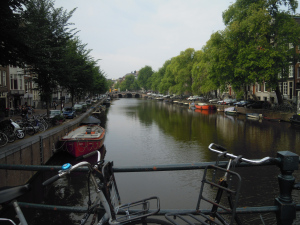
  • Amsterdam — City of Canals and Bicycles

    Robert Hughey's avatarLibations, Victuals and Other Writing

    007

    I spent a most enjoyable week in this bicycle-mad city where the canals may be one of the main attractions but when walking you have to keep your eyes sharply peeled for cyclists of all ages in some kind of a bloody hurry.

    The Van Gogh Museum was a certain delight, as was finding the Louis Bar Café De Dam at Singel 43, which overlooks a busy canal.

    006

    Here in the small environs of this bar I discovered the very fine locally brewed and unfiltered Brouwerij’T ij IPA, a 7 percent ABV stunner, with rich floral hop notes and citrus flavours stamping the palate with authority. Refreshing grapefruit comingles with juicy malt to keep the drinker returning for more. And I did.

    082 (2)Label details here reprinted on a poster in another Amsterdam bar.

    View original post

  • 2014 Miami Beach Yacht & Brokerage Show
    2014 Miami Beach Yacht & Brokerage Show

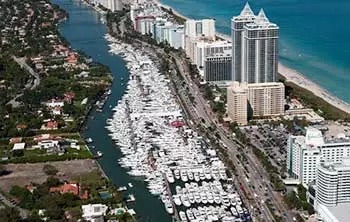
    In the heart of Miami Beach along a one-mile stretch of Indian Creek Waterway from February 12 through 16, 2015, more than 500 yachts and super yachts worth more than a billion dollars are expected for the 2015 Yacht & Brokerage Show. The show is free to the public. This boat show is unique among the many held along both Florida coasts because all of the vessels will be displayed in the water, occupying 1.2 million square feet.

  • http://www.greatloop.org/mod/ophoto/index.php?photoid=629.

    The link above leads you to the website for the extremely popular America’s Great Loop Cruisers’ Association. The Association is composed of a group of boaters fanatical about cruising America’s east coast, “including the Atlantic and Gulf Intracoastal Waterways, the Great Lakes, the Canadian Heritage Canals, and the inland rivers of America’s heartland.”

    Eva and Ron Stob started the organization when they attended a Trawler’s Fest in Melbourne, Fla., to sell their book, “Honey, let’s get a boat.” Along with the book, the Strobs offered a sign-up sheet for those interested in forming “America’s Great Loop Cruisers’ Association.” That was 1999.

    Today, the Association numbers well in excess of 250 and 70 boats, with an advisory council comprised of the founders and regular dinners at various locations.

    The maps inside the website display the various means of transiting the “Great Loop,” whether it be by sailboat or by motor boat. Quite simply, the Great Loop shown is a circular route that begins, say, in Miami, Florida, up the inland Atlantic Intracoastal Waterway north to the Hudson River in New York, north again by the New York Barge Canal (e.g., the Erie Canal) to the Great Lakes, west to Chicago, the Chicago River, or by other alternative routes to the Mississippi River or by other Midwest rivers south to the Gulf of Mexico, east along the southern coast to the Gulf Intracoastal Waterway down southerly along Florida’s west coast to the tip of the Florida peninsula, around the tip to the east coast of Florida, north back home to Miami, Florida, or other city or town along the Atlantic coast.

    Those who have cruised the entire Loop, or Loopers as they are called, recall a memorable voyage they will remember the rest of their lives.

  • In 1927, Congress authorized the U.S. Army Corps of Engineers to take possession of the Florida East Coast Canal on the condition that the State of Florida provide a “local sponsor” to acquire and turn over to the federal government at the State’s sole expense the the entire private canal owned by Harry Kelsey, then a Palm Beach County land developer, as well as any right-of-way needed to enlarge the waterway.

    The local sponsor was also to acquire and maintain spoil areas where the Army Corps could deposit spoil from future dredging. The 1927 Act required the federal government to enlarge the waterway and maintain the depths and widths of the waterway.

    By 1929,
    the State Legislature had created the Florida Inland Navigation District (FIND) to act as local sponsor. In turn, FIND issued over a million dollars worth of bonds to buy the waterway from Kelsey for $725,000. In 1929, FIND turned over the Canal to the federal government, the toll chains were dropped, and the Canal became a public, federally controlled waterway called the Atlantic Intracoastal Waterway, free of the burden of tolls.

    This special taxing district is now made up of the twelve east coast counties. These counties provide a small portion of total real property taxes to fund the District. Unfortunately, the federal government has failed to live up to its end of the bargain, providing on average 20% of the cost of maintenance. FIND picks up the balance. Other states like South Carolina have no similar taxing district to pick up the shortage of federal funds for that state’s portion of the ICW. Accordingly, shoaling is prevalent in these states where vessels often run aground as a result of poor maintenance.

    The spokesman in this video is Mark Crosley, Executive Director of FIND. While the focus is on Palm Beach County, most of the tape is equally applicable to the entire State of Florida. The material in this presentation is based in large part on my research and my book, “Florida’s Big Dig,” the story of the Intracoastal Waterway.

  • Rare footage recorded on Thomas Edison Moving Picture paper film in May 1898 at Tampa, Florida.

    This film records African-American troops walking down a steep plank as they disembark a troop steamer in May 1898 returning from fighting in Cuba during the short-lived Spanish American War. The plank was especially steep because the disembarkation occurred during high tide. The white men in command seem to ‘encourage’ the black troops down a very steep and dangerous plank.

    Henry Plant, his railroad, and the Port of Tampa on the west coast of Florida won the battle against Henry Flagler, his railroad and the Port of Miami for the lucrative contracts associated with the Army and Navy staging the American disembarkations to Cuba.

    News accounts reflect that the Army dispatched survey parties to determine which coast and railway would serve the military better. One of the east coast surveyors, Captain David Gaillard, a cousin of the Florida canal company’s Henry Gaillard, would later supervise the grueling work of cutting through a mountain in constructing the Culebra Cut in the Panama Canal.

    The Florida canal company also won a lucrative contract over Henry Plante to move mortars and large guns via the unfinished Florida east coast canal, later to be known as the Florida portion of the Atlantic Intracoastal Waterway.

  • A double-bascule drawbridge closed down on a mega-yacht cruising down the Atlantic Intracoastal Waterway, causing extensive damage to the flybridge.

    Slated for the Miami Boat Show, the vessel sustained so much damage it is unlikely the yacht will appear for the show, which annually draws thousands to the international event.

  • Built during the latter part of the First Canal Era, this canal completed the link between the Mississippi River and Lake Michigan, running 96 miles from the Chicago River to the Illinois River. The link opened up the Midwest’s agriculture, and later its industry, to the Atlantic Ocean via the Great Lakes. At first, towpaths paralleling the canal allowed horses to tow the long slender canal boats, first transporting passengers, then produce, coal, and iron. Then steam engines performed the work of the horses faster and more efficiently. The canal employed 15 locks; only one restored lock exists today, shown in this video. The elevation change from beginning to end was approximately 110 feet.

    The Canal closed in 1930 with the completion of the Illinois Waterway after drainage projects financed by the federal government eliminated the swampy lands of northern Illinois which made the land impassible even by canal ways. The railroad brought faster and more efficient means of transportation of passengers, coal, timber, and other goods. Soon after the Civil War ended, railway transportation supplanted slower inland waterways in moving the nation’s commerce. Chicago quickly became the largest city in the Midwest, its major transportation hub, and a major center for the meat packing industry.