Florida’s Big Dig

The story of the Intracoastal and other thoughts on water, waterways, land, and ecology

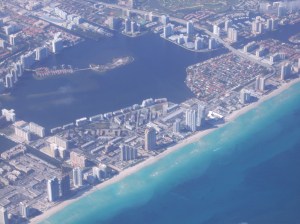
  • Dumfoundling Bay, surrounded by Aventura, North Miami, and North Miami Beach. Part of the Intracoastal Waterway.
    Dumfoundling Bay, surrounded by Aventura, North Miami, and North Miami Beach. Part of the Intracoastal Waterway.
    North of Biscayne Bay is a small geographic feature known more accurately as Dumfoundling Bay, part of today’s Atlantic Intracoastal Waterway in Miami-Dade County, Florida.

    After federal takeover of the Intracoastal in 1929, the Florida Inland Navigation District (FIND) began the process of surveying the contour of the waterway as well as any other rights-of-way needed by the Army Corps of Engineers to deposit spoil to be removed in enlarging the width and depth of the waterway under the 1927 Act of Congress. Appointed by FIND to survey the waterway in the three southernmost counties was a very competent but salty-tongued Fort Lauderdale engineer, John Charlton.

    If anything, John Charlton was punctilious about the precise spelling of the names of every geographic feature along the Florida waterway. When Charlton reviewed the spelling of the Dumfoundling Bay, he noticed there were two other variants in spelling the small bay leading to the larger Biscayne Bay.

    Various maps going back to the early 1800s spelled the feature Dumbfounding Bay and Dumbfoundling Bay as well as the Dumfoundling Bay. Fortunately, Congress established a Board of Geographic Names to hold hearings, receive evidence, and make the final decision on spelling geographic features throughout the United States where such features had conflicts in naming.

    Charlton submitted numerous maps, supporting material, even a sarcastic poem justifying the historical usage on maps for hundreds of years past naming the feature “Dumfoundling Bay.” After all, Charlton observed, naming the feature “Dumbfoundling Bay would result in naming it a “speechless orphan.”

    In 1932, the U.S. Board of Geographic Names put the matter to rest, finally siding with Charlton and with the less controversial “Dumfoundling Bay.” Although one may see it spelled differently today in sloppy media, the correct and official name has already been decided otherwise by the governmental board whose job it is to decide these questions to insure uniformity in the naming of features on maps and thus prevent confusion.
    Confused?

  • Last year, I led my first tour on the Intracoastal Waterway about this time of year while aboard the ubiquitous WaterTaxi in Fort Lauderdale, Fla. The participants were Road Scholars, a program devised by the Cambridge, Mass., non-profit organization that launched ElderHostel some years ago, today a worldwide lifetime learning program.A Road Scholar trip on the Intracoastal

    Participants ranged in age from 50 to 75 who want something out of travel ,than just travel, a destination, and maybe the city bus tour with some history but mostly humor and tales my grandmother would never tell me.  The groups are comprised of highly intelligent former or current teachers, engineers, doctors and other professionals. The Road Scholar people think of everything to make the trip comfortable, interesting, and educational.  On the Intracoastal Waterway boat tour last year, I had a headphone and each Scholar had his or her own set of wireless, adjustable, channelized ear buds that masked out undesirable waterway noise, so that each Scholar could hear me–or not.

    This year we were without our WaterTaxi, but we decided to use the ear buds anyway for comfort.  I gave a seventy-five minute talk on the history of the Intracoastal using PowerPoint slides that tell the story of how Florida got its section of the Atlantic Intracoastal Waterway, a privately owned tollway before the Army Corps of Engineers assumed control and removed the six toll chains in 1929.  No one went to sleep during my talk.  Not one.  The venue for my lecture, The Riverside Hotel, could not have been more accommodating.  I’ll give four more lectures there in the coming weeks to more Road Scholars spending a week here.

    The rest of the lineup is spectacular.  Patsy West, a leading expert on the Seminoles, will lecture on our Native American history and provide lunch in her charming turn-of-the-last-century Dade County pine, vernacular-style home on the New River.  Elliot Kleinberg, writer for the Palm Beach Post and author of numerous books on Florida history, including his award-winning book on the 1928 hurricane that devastated Palm Beach County and the Everglades, will also lecture in his energetic, humorous style. The Road Scholar people definitely have their act together.  Their online brochure even identifies activities by physical exertion level so you know ahead of time whether a particular tour is something within your capabilities.  If you’re looking for entertaining and educational travel plans, this program is for you. Look at their website near the time you’d like to travel. They have hundreds of listings throughout the country and the world.  Listings are subject to cancellation depending upon interest.

    Website: http://www.roadscholar.org. The author has no financial interest in these travel programs. The author is paid an honorarium for each lecture just as he has been paid by other organizations for lectures at other times and places.

  • This is sometimes referred to as the Giant Orange of Melbourne, Florida. Erected in 1967 from concrete and steel, the Orange is fifteen feet in diameter.  Not to burst too many bubbles but there are several such Giant Oranges throughout Florida. For several years, the Eau Gallie Chamber of Commerce operated it as a orange juice stand.

    Giant Orange of Melbourne, Fla. (1967)
    Giant Orange of Melbourne, Fla. (1967)

    The Rotary Club of Melbourne, Fla.,erected the stand in honor of the Disabled American Veterans. Melbourne is the second largest city in Brevard County and is part of or tributary to the St. Johns River system. Readers will recall the public hearings in 1922 called by the Corps of Engineers that initially selected the St. John’s River system over the old privately owned Florida East Coast Canal for conversion into the Intracoastal Waterway. While the Corps of Engineers initially selected the naturally deeper St. Johns River, the appointment of Col. Gilbert Youngberg as the new Florida chief of the Corps of Engineers in 1922 along with the leadership of Daytona developer and publisher Charles Burgman of the Association of the Florida East Coast Chambers of Commerce persuaded the Chief of the Army Corps of Engineers to change its recommendation to the Florida East Coast Canal for conversion into the Intracoastal Waterway.florida tourism

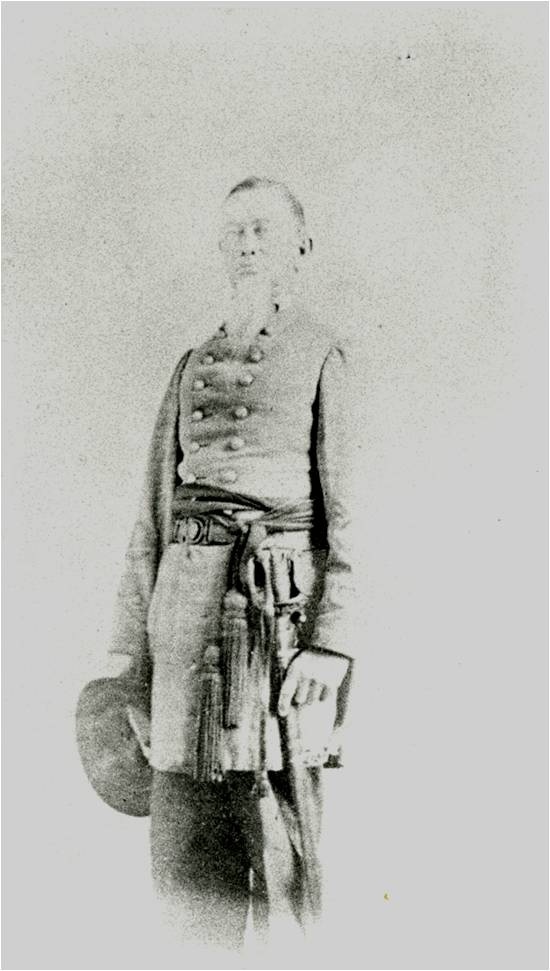
  • Dr. John D. Westcott (1807-1889), Surveyor General of Florida (1855) Pres. Florida canal company (1881-1889). Courtesy, Museum of the Confederacy, Richmond, Va. (Carte d' visite).
    Dr. John D. Westcott (1807-1889), Surveyor General of Florida (1855) Pres. Florida canal company (1881-1889). Courtesy, Museum of the Confederacy, Richmond, Va. (Carte d’ visite).

    Florida did not become a state until 1845. In the Treaty with Spain in 1819, the East and West Floridas would become the Territory of Florida under federal jurisdiction in 1821 until the “territory” became a “state” under the United States Constitution. Most of the meager population inhabited the extreme northern portion of the territory. The Everglades would not even be surveyed by the federal government until 1910.

    It was still the Wild West in the Sunshine State. After the Civil War, there were still few settlers in south Florida because there was no means of transportation. Nevertheless, as early as 1838, entrepreneurs applied to the governor and the territorial council for charters to construct and operate railroads and inland waterways as private corporations. After 1845, the procedure changed little.

    Applications were made to the new State Legislature. Until the Legislature passed a general corporation act permitting persons to apply for and receive charters pro forma if certain requirements were met, applying for and receiving charters to conduct business as corporations remained a cumbersome and political procedure.

    Before and after statehood but before the passage of eminent domain law permitting certain public bodies given such power to take property under judicial supervision, railroad and canal companies enjoyed the special privilege of the ancient writ of ad quod damnum. Upon unilaterally deciding that it was necessary for one or both of these two types of transportation companies to extend a railroad or canal through private property, in the absence of mutual agreement on the price of the taking, a railroad or canal company could apply for a writ to the local county judge, who, in turn would empanel twelve residents to determine the value of the taking.

    As soon as the company paid the sum determined, the proceedings ended and the company could extend its railroad or canal work on private property, without the usual delays, convoluted legal procedures, and payment of exorbitant attorney’s fees. In 1881, a financially destitute State of Florida agreed to incorporate four St. Augustine entrepreneurs to dredge what would become the Florida portion of the Intracoastal Waterway for a million acres of east coast state land and the right to collect tolls upon the waterway’s completion in 1912.

  • Built on June 11, 1764, at Sandy Hook, N.J., Sandy Hook Light is now located about one and one-half statute miles from the tip of Sandy Hook as a result of the natural occurrence of littoral drift. Its original location was only 500 feet from the tip. The natural accumulation of sand drifting in the same direction from the action of currents in the water added nearly one and a half miles of beach land.

    Sandy Hook Light (1764) Oldest Working Lighthouse in the U.S.
    Sandy Hook Light (1764)
    Oldest Working Lighthouse in the U.S.beach land to the tip of Sandy Hook.

    Originally called the New York Lighthouse because the funds to build it were derived from a lottery conducted by the New York Assembly, the light was needed to aid ships coming into New York Harbor. The conducting of lotteries was not an unusual means of raising funds for internal improvements in early America. When the Constitution was adopted and the United States of America came into existence, the State of New York conveyed the lighthouse and land to the Federal government.

    Other lighthouses were treated differently. Because of anti-Federalist sentiment limiting the powers of the federal government under the Constitution, the federal government agreed to pay only for lighthouses and their keepers as long as the States contributed and maintained the land on which the lighthouses were to be built. The same restraints that limited the federal financing of inland waterways also limited the financing of railways and lighthouses.

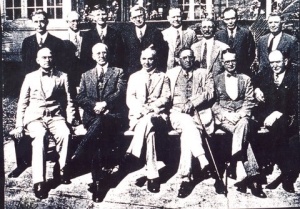
  • FIND 1928
    The first Board of Commissioners of FIND, included, yacht club commodores, newspaper publishers, landscape architects, real estate developers. Here, pictured also are Al Green, first attorney for FIND; and, Harry Kelsey, current owner of the Florida East Coast Canal (1928). Courtesy, FIND.

    Under the 1927 federal legislation authorizing the Corps of Engineers to take control of the Florida East Coast Canal for conversion into the larger Intracoastal Waterway, Congress required Florida to designate a local sponsor. That local sponsor designated by the Florida Legislature was FIND, a special taxing district made up of eleven east coast counties stretching from today’s Miami-Dade County (Miami) north to Duval County (Jacksonville).

    Now FIND includes a twelfth county (Nassau County) further north. This district has the power of taxation over all property within these 12 counties, as well as the powers of eminent domain, and all other powers necessary to provide in perpetuity the maintenance spoil areas needed by the Corps of Engineers to deposit spoil in enlarging the waterway to a minimum width of as much as 150 feet in some areas and a depth of twelve feet, as it exists today in Florida.

    Here in this photograph are the eleven members of the original board of commissioners, including Harry Seymour Kelsey, who bought the East Coast Canal from George Ł. Bradley’s estate in 1925, and other officials. The majority of the commissioners appointed by Governor David Sholtz in 1927 were yacht club commodores, newspaper publishers, and real estate developers, in addition to others interested in inland transportation.

    In 1929, as a result of court delays caused when Dade County State Attorney Vernon Hawthorne challenged FIND’s intention in selling bonds to buy the waterway from Kelsey, FIND sold something over one million dollars in bonds to pay for the old Canal and necessary right-of-way. Title was then vested in the United States of America, the Corps of Engineers assumed control over what Congress would later call the Atlantic Intracoastal waterway, and the old toll chains were eliminated. The old Canal became a free and public waterway of the people of the United States of America.

    Postscript. After all was said and done, FIND did not spend all of the bond proceeds. The commissioners “burned” the bonds they didn’t need to sell. One of those noteworthy instances when a public body didn’t spend all of the proceeds of a court-approved bond issue.

  • 

    The Matanzas Inlet is eighteen miles south of St. Augustine at the the south end of the St. Johns County barrier island. On the south side of the inlet is the barrier island to Ormond Beach, another twelve miles.  West of the barrier islands is Fort Matanzas National Park.  The absence of jetties at this natural inlet makes possible the continued shifting north of the Inlet by natural Atlantic littoral shifting described in another posting that has been an ongoing process for at least a hundred and fifty years.  The waterway running north and south through the inlet inside the barrier islands is the Matanzas River reach of the Intracoastal Waterway.

    In 1882, when the Florida Coast Line Canal & Transportation Company (“the Florida canal company”) began the actual work of dredging what would become the Intracoastal Waterway, the company started its work with one dredge south of St. Augustine working south and another dredge at Ormond Beach working north.

    Using crude continuous bucket dredges, the work was difficult, almost incorrigible in many places. The Inlet shown in this photograph made that part of the work even more challenging, introducing swirling currents, tides, and beach sand as well as rock, coquina, and mud. 

    Because the State of Florida agreed to grant the company 3,840 acres of public land for every mile of waterway dredged, the canal company soon moved the work south into easier cuts such as the Indian River Lagoon.  The lagoon was a waterway of sorts but not navigable in any sense of the word.

    A canoe could traverse the large body of water but its depth barely exceeded a few feet in many places.  The State of Florida required a waterway at least five feet deep. The canal company cut a navigable pathway through the lagoon and marked the Lagoon’s depth at five feet and width of fifty feet as required by the State, even though the large sheet of water expanded to as much as four miles wide in some places.

    Florida's Big Dig's avatarFlorida’s Big Dig

    Matanzas Inlet -South St. Johns County Matanzas Inlet -South St. Johns County In 1881, the private St. Augustine-based Florida canal company agreed to dredge an inland waterway from Miami, Fla., to St. Augustine, Fla., and later to Jacksonville, Fla., a distance of approximately 400 miles. For every mile of waterway dredged, state legislators agreed to convey to the canal company 3,840 acres of state-owned land. Upon the delivery of the last (12th) deed to the canal company, the State had granted the canal Company a little over a million acres of public land.

    Of the total length of the waterway, between 80% and 85% of the total was pre-existing waterway. Nonetheless, of that 80% to 85% of the waterway, much of it required the dredging of safe, uniform channels as we see them today in the Intracoastal Waterway.

    Moreover, both artificial and natural inlets dot Florida’s east coast making difficult maintenance of the waterway at these…

    View original post 73 more words

  • 1892 northeast Florida map showing towns and cities as well as railway routes and private canal (inland waterway) routes along with promised land grants for opening up transportation in Florida.
    1892 northeast Florida map showing towns and cities as well as railway routes and private canal (inland waterway) routes along with promised land grants for opening up transportation in Florida.
    In 1881, the Florida canal company asked for and received a state land grant of 3,840 acres for every mile of waterway dredged. Henry Flagler asked for the same land grant for every mile of railway track laid. But Flagler was years late in making application because the Legislature had reserved for granting more east coast land than the State possessed. A mathematic error made more times than mere happenstance would allow. Graft? Corruption? The author leaves it to the reader to speculate.

    In any event, with Author’s tongue fully in cheek,Flagler stopped construction of the Florida East Coast Railway “in its tracks” at Titusville, vowing that he would not complete the railway to Miami unless landowners and cities along the way, including the Florida canal company, chipped in their fair share of state land grants.

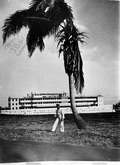
  • In the 1930’s, Commodore Avylen Harcourt Brook, second chairman of the Florida Inland Navigation District, diligently worked with community leaders to bring the Amphitrite, a floating hotel and restaurant to Fort Lauderdale. Actually, the Amphitrite served as a warship in the Spanish-American War and the First World War; later, she was decommissioned and sold to investors, who converted her into a floating hotel and restaurant. In Greek mythology, Amphitrite was the wife of Poseidon.

    Amphitrite
    The “Amphitrite,” floating hotel

    The Amphitrite seen here in the New River Sound, a large body of water of the Intracoastal Waterway, in Fort Lauderdale, Florida, with its bow facing north.  The floating hotel boasted a number of amenities in addition to serving as a hotel and restaurant.

    Ultimately, the ship was not financially successful. The coups d’grace was delivered when a hurricane blew her from her mooring to another part of the Intracoastal. Over the years, the ship became something of an ‘eye sore’ from lack of maintenance. She was not missed by local residents when the old vessel disappeared during World War II, according to local legend.

    As fantastic as a floating hotel may seem, Palm Beach County investor Harry Seymour Kelsey, developer of Kelsey City, now Lake Park, Fla., planned in the early 1920’s when he bought the Florida East Coast Canal from the estate of George Ł. Bradley to install a string of floating hotels along the Canal. His sale of the waterway to the State of Florida for later transfer to the federal government for conversion into the Intracoastal Waterway interrupted his master plan of “floating hotels” along the waterway.

    William G. Crawford, Jr., Esq.
    Author of “Florida’s Big Dig”

  • Lake Mabel
    Lake Mabel (Port Everglades) taken in 1925 before the incorporation of the port with the Atlantic Ocean in the foreground. Courtesy, Broward County, Fla.

    In his 1870 Government Map of this section, Surveyor General Marcellus Williams named this feature Lake Mabel after Mabel, fiancee’ of James White. White and Mabel accompanied the surveying party along with Williams’s son, Arthur T. Williams.

    The Intracoastal Waterway runs through the middle of the Lake, paralleling the east coast of Florida from what had been named the New River Sound on both sides of the inlet.

    Arthur T. Williams became quite famous throughout the State, accumulating large parcels of land with and without his partner, James A. Harris. The name Lake Mabel is confirmed in the register of the Board of U.S. Geographic Names.

    In the background, one can see the outlines of the making of the City of Fort Lauderdale’s new municipal airport, which was later named the Merle Fogg Airport, after a young aviator (Fogg) crashed and died west of West Palm Beach with his student at the controls. After World War II transformed Fogg Field into Naval Air Station (Fort Lauderdale), a large training base for Navy aviators, the Navy turned over the Airport to Broward County. The airport is now the Fort Lauderdale-Hollywood International Airport.