Florida’s Big Dig

The story of the Intracoastal and other thoughts on water, waterways, land, and ecology

  • Of the 34 million acres or so that make up the State of Florida, water comprises a substantial portion of it.  At the top of the water management  pyramid sits the Secretary of the Department of Environmental Protection.  Under the Department, five Water Management Districts manage a system of nine primary canals and their basins or “C” canals, which are identified by the letter “C” followed by a number. 

    In the South Florida Water Management District (SFWMD), one of the more recognizable primary canals in Broward County is the C-11 canal or the Griffin Road or South New River Canal.  The four other water management districts in Florida are the Northwest Florida Water Management District, the Suwanee River Water Management District, the St. Johns River Water Management District, and the Southwestern Florida Water Management District.

    The Florida legislature enacted legislation in 1949 creating the Central & Southern Florida Flood Control District (C & SF FCD)  when a massive 1947 hurricane along with several other tropical events drenched south Florida with ten inches of rain within a short period of time. What would become the city of Planation and the Town of Davie as well as the rest of western Broward County were completely under water, cut off from Fort Lauderdale.  Flood waters drenched even the streets of Fort Lauderdale, flooding downtown offices and retail shops. The Army Corps of Engineers launched a twenty-year construction program to prevent future flooding.  The legislature replaced the C & SF FCD with the SFWMD when Congress passed the Water Resources Act in 1972.

    In Broward County, today, primary canals and their basins, along with an intricate system of secondary, and even tertiary canals comprising, in the aggregate, 266 miles of waterways within the SFWMD, managing water flows which eventually outpour to estuarine areas like the Atlantic Intracoastal Waterway, with one exception. That one exception is the western section of the C-11 primary canal, which back-pumps water for storage into Water Conservation Areas (WCAs), as shown on the map.

    Major secondary canals include the Lake Worth Drainage District (LWDD) which covers south Palm Beach County.  Incorporated in 1905, the LWDD is one of the oldest drainage districts in Florida. This year, the LWDD celebrates its 100th birthday since the swearing-in of its first commissioners; I’ll be there as the keynote speaker on June 17th.  In the early 1900’s,  the election of Theodore Roosevelt to the presidency along with the election of Jacksonville, Florida tugboat captain Napoleon Bonaparte Broward  to the gubernatorial post led to a renaissance in the building of canals throughout the state, especially those in connection with Broward’s plan to drain the Everglades. Between 1905 and 1935, the Florida legislature incorporated more than 125 drainage districts throughout the State of Florida.
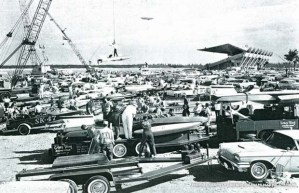
  • In the years after the end of World War Two, Sam Griffiths, owner of the Pelican Harbor Yacht Club and a power boat enthusiast himself, organized the ultimate power boat race, the Gold Coast Marathon, which ran in the Intracoastal Waterway from his Club just south of the 79th Street Causeway to West Palm Beach, returning to Miami the next day.  The Marathon ran from the late 1940’s to the early 1970’s.  Some of the hydroplanes approached 100 mph, many averaging 50 mph to 60 mph, reaching West Palm Beach in an hour.

    Contestants in the Gold Coast Marathon off-loading their hydroplanes and other power boats
    Contestants in the Gold Coast Marathon off-loading their hydroplanes and other power boatshydroplanes approached 100 mph, with average speeds from 50 mph to 60 mph, reaching WPB in one hour.

    In later years, the danger of hundreds of boats in thirteen classes running in the Intracoastal led to fatality and injuries, forcing Griffiths, a three-time winner, to move the event to an oval course at the sleek, ultramodern Miami Marine Stadium.  Even running on an oval course led to the death of a world class Italian driver. Ultimately the race’s danger coupled with the diminished novelty of the event over the years led to its ending.

    Today, a group of preservationists has formed a nonprofit corporation seeking to restore the ultramodern Miami Marine Stadium to its former glory. But for now, the rusty Stadium bears the years of abuse along with the usual graffiti of an abandoned structure.  In the opinion of the author, the Stadium’s restoration is a worthwhile project. The architecture is significant of the very best in modern south Florida architecture.  It deserves restoration to its former beauty along with its interpretation and preservation for the enjoyment and education of present and future generations.

    William G. Crawford, Jr., Esq.

  • MANAGEMENT OF INVASIVE AQUATIC PLANTS IN DISTRICT CANALS

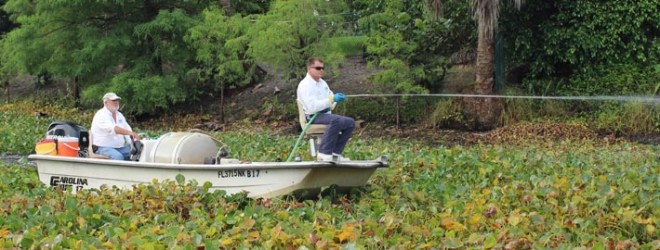
    Managing invasive aquatic plants within the Lake Worth Drainage District, using environmentally safe herbicide spraying.
    Managing invasive aquatic plants within the Lake Worth Drainage District, using environmentally safe herbicide spraying

    The year 2015 marks the Centennial Celebration of the Lake Worth Drainage District.  In 1915, as a result of state legislation, this District came into being to drain excess water during the rainy season and contain water during dry seasons through an intricate system of monitoring, pumps, and locks to prevent flooding.

    In later years, the District’s mandate has been enlarged to assure safe and clean water for Palm Beach County’s ever-growing population.  Here, District workers spray herbicide to control the spread of fast-growing aquatic vegetation that hampers the use of canals where allowed and threatens to clog expensive pumps, locks, and other expensive machinery. The District encompasses the old Palm Beach Farms Company tract, comprising some 234 square miles from Okeechobee Boulevard south to the the south boundary line of Palm Beach County.

    New board members will be sworn in on June 17, 2015.  Courtesy, Lake Worth Drainage District.

  • Other methods of controlling invasive plants with accelerated growth patters include the use of mechanical chopping machinery.  But such methods depend on accumulating plants in quantities large enough to make destruction by mechanical means economical.  Courtesy, Lake Worth Drainage District.

  • Ft. Lauderdale attorney and historian William G. Crawford, Jr., author of the award-winning “Florida’s Big Dig,”  was interviewed to air on C-Span 2  Book TV Saturday, May 16th and again Sunday, May 17th, 2015.  
    The link to the interview at any time: http://www.c-span.org/video/?325649-1/book-discussion-floridas-big-dig#. Copy and paste to browser to view interview.
    The 2008 winner of the prestigious Rembert Patrick award for the best academic book on a Florida history topic, “Florida’s Big Dig” is the story of the financing and construction of the Florida link in the Atlantic Intracoastal Waterway, one of the largest public-private construction projects in the history of Florida. 

    For building a continuous inland waterway from Jacksonville, Fla., to Miami, Fla., the St. Augustine privately financed company won over one million acres of public land along the coast from St. Augustine to Miami and the right to collect tolls until the old canal became a federal waterway in 1929.  The program will air perennially, depending on programming requirements.  DVDs of the various programs, including this interview, will be sold by C-SPAN TV, Washington, D.C.  See end of Interview for purchasing information.

  • The City of Fort Lauderdale has promoted itself as the ‘Venice of America’ for almost  a century because of its  more than one hundred miles of manmade and natural canals throughout the 36-square-mile city.  But before it proclaimed itself the ‘Venice of America’ beginning in the 1920s, its weekly newspaper advertised the town on its masthead as the ‘Gateway to the Everglades’.  Under Governor Napoleon Bonaparte Broward (1905-1909), the State of Florida began a massive project to drain the Everglades to open up millions of acres of arable land for agriculture on a scale the world had never known.  The plan was to dredge five canals from Lake Okeechobee to both Florida coasts. The first to reach the Lake was the New River Drainage Canal in 1912, starting at Fort Lauderdale; hence the moniker, ‘Gateway to the Everglades’.

    “Some tourists think Amsterdam is a city of sin, but in truth it is a city of freedom. And in freedom, most people find sin,” from “The Fault in Our Stars.”   Amsterdam, nicknamed the “Venice of the North,” is a city I would like to visit as part of my Wanderlust Wednesday. My friend, […]

    http://adventureswithanna.com/2015/04/15/wanderlust-wednesday-the-venice-of-the-north/

  •  Benjamin Franklin's map of the Gulf Stream

    At least to this author’s mind, one of the greatest enigmas in all of Florida history is the insertion in the 1868 Florida constitution of the “Gulf Stream” as the eastern boundary of the Sunshine State. It is unique among the state constitutions of every state in the Union.  No other state uses an indefinite, amorphous and ever-changing geographical feature in describing at least one of its boundaries. Benjamin Franklin was the first to map this feature in 1760.  The stream runs as close as three miles and as distant as two hundred miles from the east coast. The feature changes so rapidly that in a single day, the Gulf Stream changes as much as ten or more miles in width.

    Other states use boundaries such as rivers to separate states or the banks of lakes to define their boundaries. Still others, like the coastal states, use statute miles or leagues from the shoreline to define their coastal boundaries, contemplating matters like the distances a cannon ball could be fired from an enemy ship. It’s true that the boundaries of rivers change–over time. But, generally, changes in the courses of rivers depend upon erosion and other natural, predictable, slow-moving changes over time.

    Second, the circumstances under which the “Gulf Stream” boundary was inserted remain a mystery subject to speculation.  At the conclusion of the Civil War, before a seceding state could be readmitted to the Union, such state would be required to submit to Congress an acceptable constitution.  In 1868, a duly constituted convention of delegates met in Tallahassee, at the Capitol, and adopted a conservative constitution. A group of radicals bolted the convention and met several miles away at the small town of Monticello. A new “radical” state constitution was adopted under guard behind closed doors.  No complete set of minutes of those meetings survives.  We only know that Congress accepted the “radical” constitution adopted at Monticello and readmitted the State of Florida back into the Union.  The insertion of the Gulf Stream in the 1868 constitution survives to this day.

    Its usefulness is doubtful in light of federal law; but as a matter of state history, there it is. And it has never been changed.  Some speculate Florida simply wanted to “flex its muscles”; others believe that the expansion was a protection of important fishing rights in disputes with the Bahama Islands.  Nevertheless, it remains a conundrum without a resolution. Perhaps some day we may know the real reasons for the language.  But for the moment, it remains a mystery.

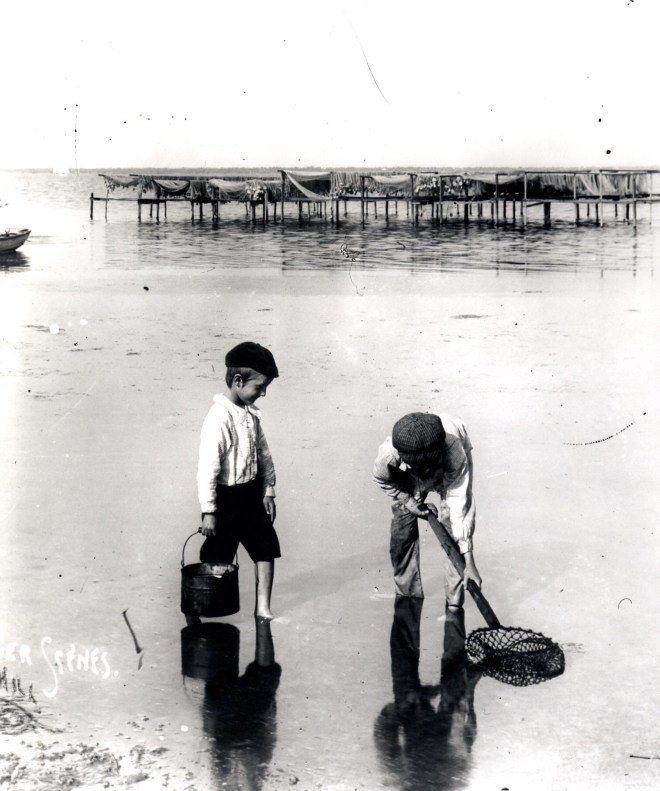
  • Small boys digging for clams along the east bank of the Indian River Lagoon, ca. 1890's.  Collection of the Author
    Small boys digging for clams along the east bank of the Indian River Lagoon, ca. 1890’s. Collection of the Author
  • As of yesterday, a dangerous navigational hazard has not yet been marked at Watts Cut (AICW mile marker 503). A concrete pole was driven in an angle into the bottomland of the Intracoastal Waterway.

    http://cruisersnet.net/cruisersnet-marine-map/?ll=32.61883333,-80.359&z=1

    Under certain tidal conditions, the pole cannot be seen above water.  Striking the pole at speed will result in a hole in the hull of many vessels. Under other conditions, striking the pole at an angle at speed may cause passengers to be thrown overboard. The Coast Guard has been alerted.

    Of all the coastal counties through which the Intracoastal Waterway runs from Virginia to Florida, clearly the run through South Carolina poses the most risk for boaters on the Intracoastal Waterway.  From navigational hazards like this concrete pole to shoaling so severe a person can actually walk across the bottomland of the Waterway at low tide in some sections, the Palmetto State alone cannot maintain its waterway.  A missing link in a continuous inland waterway defeats the whole purpose of having a continuous waterway for pleasure or commercial purposes.  Congress still has not appreciated the millions of dollars spent by the megayacht and yachting industry.

    Under federal law, the Waterway is to be maintained by the federal government through the Army Corps of Engineers.  Generally, the Waterway is to be kept at a depth of 12 feet.  Congress has failed to provide sufficient funds to the Army Corps of Engineers for maintenance. Fortunately, when the federal government assumed control over the old Florida East Coast Canal in 1929, Florida formed a special taxing district, the Florida Inland Navigation District (FIND), to provide the necessary easements and areas for the deposit of maintenance spoil required by the Corps of Engineers.  With federal funds lacking, FIND supplies 80% of the necessary funds to maintain the waterway through dredging in partnership with the Corps. The remaining states along the coast must rely on general state revenues.

    In 1999, business interests in Virginia, North Carolina, South Carolina, Georgia and Florida combined to form the Atlantic Intracoastal Waterway Association to lobby Congress for adequate funding.  The stimulus program provided some but not enough to fill the long term needs of the Waterway. And the AIWA has made some progress on Capitol Hill, but there is still much work to be done.

  • The sloop

    On the sloop “Klyo,” in the New River Sound, Fort Lauderdale, Florida, were President-elect Warren Harding (in white pants and white shoes, standing in the middle with cap doffed in right hand) and owner, Commodore Avylen Harcourt Brook (short-statured, standing in the middle of two taller men in the stern with flat captain’s hat (1922)).  Courtesy, Fort Lauderdale (Fla.) Historical Society. The event, or “stunt”, attracted coverage from newspapers across the country, inciting action for a second renaissance in inland waterways construction and improvements.  More than thirty citizen groups coalesced to lobby for waterways throughout the country.