I am Bill Crawford. I was born and raised in Ft. Lauderdale, Fla., bisected by the Intracoastal. I graduated from the University of Virginia with a bachelor’s degree in commerce, with distinction, concentrating in finance. I obtained my juris doctor degree from Stetson University College of Law. I have practiced law for more than 43 years. I am a professional historian and author of the award-winning book, “Florida’s Big Dig,” (2008) the story of the Atlantic Intracoastal Waterway.
I have practiced law in Florida since 1975. Along the way, I developed a keen interest in researching and writing history, publishing numerous scholarly journal articles and one award-winning book, “Florida’s Big Dig,” the story of Florida’s Atlantic Intracoastal Waterway, using my legal pbackground to understand legal transactions, deeds, wmortgages, bonds, preferred stock, and legal descriptions of land and water.
In recent years, I have maintained a limited practice consulting with other professionals on various historical land and water issues, including sovereign, riparian, and submerged land rights, focusing on the Atlantic Intracoastal Waterway and Florida inland waterways.
I maintain a broad regular website here at www.floridasbigdig.me and a website solely on how the book was researched as well as some of the major themes explored. The website on the book itself is at www.floridasbigdig.com.
The website on contacts for professional services is at www.floridasbigdiglawyer.com?. A fifteen-page outline of my book
This video is a basic description of how the Everglades became dysfunctional and what needs to be done to restore the historic flows south, so that the flora and fauna desecrated by a lack of clean water and uncontrolled invasive plants may thrive once again.
California governor Jerry Brown has ordered an historic 25% cut back in water usage throughout the State, The drought has been deemed “catastrophic.” One water irrigation district has sued the State of California for state action which will ruin entire agricultural industries. Calfornia produces over 90% of the Nation’s strawberries, brocolli, walnuts, and plums. The photographs below depict the topography of the land at Enterprise Bridge over Lake Oroville in 2011 and again, recently. A San Francisco resident reports that he and his neighbors have taken out bank loans to drill 2,000 feet for water. NASA predicts that California will be compleletly out of water by next year.
Aerial of Harbour Town Marina, Sea Pines Plantation , Hilton Head Island, South Carolina
Built in 1969 by acclaimed developer Charles Fraser, Harbour Town Marina has 100 slips on Calimbogue Sound, the second largest sound on the Atlantic coast (Long Island Sound is the largest) and part of the Atlantic Intracoastal Waterway. Designed by renowned land planners Wallace Robert & Todd and Sasaki & Associates, the Sea Pines development includes, condominium apartments, a retail shopping center, a championship golf course and pro shop, a tennis center, two stand-alone restaurants as well as a hotel and Marriott time-share development. The master plan also includes an iconic working lighthouse. Legend has it that the firms almost came to blows over the design of the lighthouse striping.
The Lake Worth Drainage District celebrated its (1915-2015) centennial yesterday. Between 1915 and 1935, more than 125 drainage districts formed in Florida to prevent flooding. Nineteen districts formed in Palm Beach County alone. These local districts (secondary drainage) are under the supervisory control of the South Florida Management District (primary drainage). Both monitor the weather closely and remain in close contact with each other. The SFWMD has the final say over whether the flood gates should be open or closed, based upon the total amount of rainwater expected each day.
One of the largest secondary systems, the LWDD manages the water in an area once called the Palm Beach Farms, an immense agricultural operation that resulted from the public lands granted the Florida canal company that built the Intracoastal Waterway and Flagler’s Florida East Coast Railway and their subsidiaries from St. Augustine and Miami. In total, the Palm Beach Farms Company bought approximately 234 square miles of land from the Okeechobee Road to the south Palm Beach County line in 1912. That land now lies within the Lake Worth Drainage District. The principals behind the Palm Beach Farms Company in 1912 were silver mine owners and brokers from Colorado. Headed by Percy Hagerman (1869-1950), the Florida farming company had been incorporated in Colorado.
Born in Milwaukee, Wisconsin, Hagerman graduated from Cornell University, and studied law for one year at Yale University. Adding to his family’s immense wealth, Hagerman invested in railroads and mines in Colorado Springs where he resided, in addition to his investments in Florida real estate. Old Percy Field at Cornell is named in honor of Hagerman; Hagerman Park at Colorado Springs is also named for Hagerman. Hagerman was a master rower while attending Cornell. At Colorado Springs, Hagerman became famous as an artist throughout the West for his mountainscape paintings.
Palm Beach County’s 19 drainage districts represent the secondary tier in a complex system of drainage under the supervision of Florida’s South Florida Water Management District to mitigate flooding in the wet seasons and conserve water in the dry seasons so that the County has sufficient water to meet consumer, industrial, and agricultural needs all-year-round.
Congress began investigating the swampy marsh conditions of the federal lands in Illinois and Missouri in 1826. Members made several attempts at draining the lands. But it was not until 1849 when Congress passed the first Swamp and Overflowed Lands Act granting the State of Louisiana all federal lands in the state for its successful reclamation of the lands.
The 19 special drainage districts of Palm Beach Couss passed the first Swamp and Overflowed Lands Act to grant all the federal lands in the State of Louisiana for its success in reclaiming its swampy lands into arable and otherwise useable lands.
One year later, Congress passed the second Swamp and Overflowed Lands Act (1850) to grant to the new State of Florida all federally owned Swamp and Overflowed lands reclaimed and made usable. By the early 1920’s, Congress had granted to the Sunshine State a total of 20 million acres of federal lands out of Florida’s 35 million acres –forty percent of the land area of Florida, except for Spanish, French, and Indian grants of lands, which constituted a small amount of land by comparison.
Congress’s land grants made possible the construction of the Atlantic Intracoastal Waterway when private individuals incorporated the Florida Coast Line Canal & Transportation Company to build the waterway in addition to Flagler’s Florida East Coast Railway from Jacksonville to Miami. Still, little of the swamp lands had been reclaimed except those drained in the early 1880’s by Hamilton Disston, a Philadelphia saw manufacturer. Disston drained only some of the lands in southwest Florida before he gave up the project.
The pivotal date in drainage was to be 1905. As if the stars had aligned, the election of President Theodore Roosevelt placed a new emphasis on the nation’s resources. Roosevelt convened several assemblies like the National Drainage Congress and others emphasizing conservation and inland waterways. The same year, Florida elected a progressive Democrat to begin a plan to drain the Everglades to create more land for the average farmer. Broward also promoted legislation that permitted local areas within a city or town to form special drainage districts. By 1935, more than 125 drainage districts like the Lake Worth Drainage District had been created to drain the lands within its boundaries and place liens on drained lands to enforce payment of the liens to pay for the projects.
Region: Chesapeake & Delaware Bays Date Reported: Jun 10, 2015 Reported By: Mike Ahart, News Editor Source: WG Staff
Sailboats on the Bay Courtesy:
Waterway Guide is pleased to announce that it is sponsoring the “Sail to the Sun” ICW Rally this coming fall.
“Sail to the Sun” is the creation of cruising writer Wally Moran, who ran the original ICW rally last fall, safely guiding 16 boats south from Norfolk to Miami. Wally is also a Cruising Editor for Waterway Guide.
The “Sail to the Sun” ICW Rally will run from Deltaville VA all the way through to Miami FL, where many of the participants will jump off for the Bahamas or points south for the winter.
Waterway Guide will be providing logistical support for participants, arranging marina slips and sponsoring a variety of fun events on the way south. These events will include the kickoff party and seminars in Deltaville.
Waterway Guide will also be putting together an amazing Skipper’s Swag Bag, with a great variety of gifts and goodies for each boat. Also, each Captain will receive a complimentary copy of the 2016 Atlantic ICW Waterway Guide.
“Wally has extensive ICW knowledge and experience, as well as a great rapport with cruisers through his online blog and Facebook groups. Add the support from the whole Waterway Guide crew, and I think this will be a fantastic rally,” said Ed Tillett, Waterway Guide General Manager.
For at least 150 years, individual boaters have flown aft a rectangular, triangular, or swallowtail flag called a burgee to distinguish one boat from another. More prevalent have been the burgees that distinguish one yacht club from another. The earliest yacht club is an Irish yacht club with its own distinctive colors, borders, and letters.
Burgee of America’s Great Loop Cruisers Association
In America, the oldest yacht club is the the New York Yacht Club, which has the oldest burgee in America. The burgee has but few colors, a Latin cross with the longer piece running horizontally and the shorter piece running vertically, along with a star.
Several years ago, a group of cruisers formed America’s Great Loop Cruisers Association. Full-fledged members have transited the entire loop, within a given period of time, comprised of the Atlantic Intracoastal Waterway, the Erie Canal, the Great Lakes, either the Mississippi or Missouri Rivers, the Gulf of Mexico, down the Gulf Intracoastal Waterway to Key West, returning to the Atlantic Intracoastal Waterway. Whether or not a boat is entitled to fly one or the other of the two burgees of distinction depends upon completion of transits pursuant to the rules of the Association.
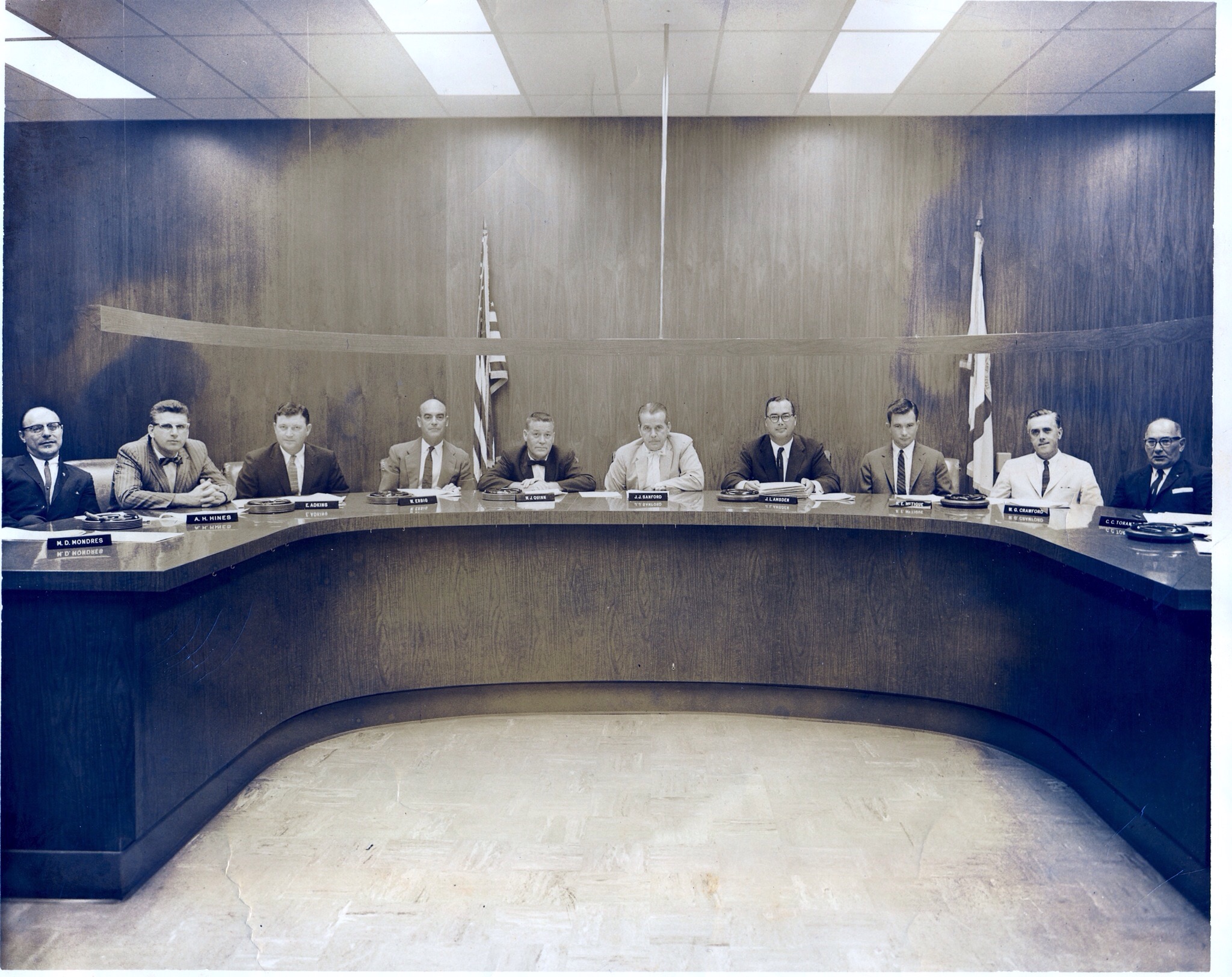
Marvin D. Mondres, Hollywood (Burke). A.H. Hines, Sec’y, Hollywood(Burke). Ephraim Adkins, Oakland Park (Easterlin). Wm. Erbig, Ft. Lauderdale (Adler). W.J. Quinn, Ft. Lauderdale (Adler), J.J. Sanford, J.L. Amsden, R. Emmett McTigue, Ft. Lauderdale (Humphries), William G. Crawford, Ft. Lauderdale (Easterlin). C.C. Torant ? Population: 1960, 330,000;1970, 620,000.
Near Moore Haven, Fla., west of Lake Okeechobee (top) new storage area for discharge of fresh water southwestward from Lake Okeechobee (bottom) before entering the Caloosahatchee River to prevent overloading the River Basin and benefit agricultural areas. The Slough project can hold up to 11 billion gallons of released fresh water each year until larger water storage areas can be completed. Six new water storage projects are underway as of May 27, 2015. Courtesy, Florida Water Daily.



 Florida’s Big Dig