Florida’s Big Dig

The story of the Intracoastal and other thoughts on water, waterways, land, and ecology

  • Especially before the Hispanic period, the dominant form of transportation was by use of the many colorful, small, slender light draft boats on the myriad canals. Over a period of several hundred years, farmers continued to grow flowers, fruits, and vegetables atop the mulch and muck lands dug by hand from the bottom of Lake Xochimilcho.

    Colorful canal boats at Xochimilco between tourist trips along 110-miles of waterway
    Colorful canal tourist boats at Xochimilco, Mexico

    Farmers then carefully placed large quantities of mulch and bottom lands above water on various varieties of long fibrous plants tied together in bundles. Workers then tied the bundles in line to small trees in the waterway. The topography of the land was not exclusively reclaimed lake land called chinampas. The colorful boats for tourists became known as trajineras. Tourists now share with farmers the 110 miles of canals snaking their way throughout the lush centuries-old muck lands growing above the surface of the lake.

    By the 20th century, the intricate complex of lakes, artificially made land, and canals had dwindled down to just a relatively small system of canals. Today the canals are still fed by fresh-water springs. But Mexico City’s population growth has stressed Xochimilco’s aquifers and cause subsidence of Xochimilco’s lake beds. Xochimilco’s  ecosystem of juniper trees and other rare species of flora and fauna are under siege by various external threats that originate with population explosion. These threats and stresses upon the land and water have resulted in UNESCO to list Xochimilcho as a World Heritage Site.

  • 1950's colorized photo postcard of reclaimed and canalized Lake Xochimilco, along with farmers on canal boats.
    1950’s colorized photo postcard of canalized Lake Xochimilco

    Predating the Hispanic Period and geographically south of the main capital city of Mexico was an ancient large lake called Lake Xochomilco. Over the centuries, beautiful flowers and agricultural products were grown above the water on tall stalks, anchored to trees and filled in the rich mulch and soils from the lake bottom. Eventually, early farmers in the area separated by the capital city built canals and colorful canal boats for transit to and from the central Mexico City with their produce.

    Over the centuries, Mexico City has grown outwardly, incorporating this former lake bed covering 48 square miles, sustaining a population of almost half a million, mostly farmers.  In 1928,  Xochomilco became recognized as an independent city.  For hundreds of years, these farmers cultivated their lush flowers, plants, and produce above the water, traveling on these colorful canal boats. On Sundays, tourists and townspeople have travelled to see these brightly colored boats filled with their produce for market. Some tourists have boarded these canal boats to tour these canals and view the ancient methods of growing produce.

    Farmers on their canal boats tending to their crops above the waters of Lake Xochimilco.
    Farmers on their canal boats tending to their crops

    Despite Xochomilco’s status as an independent city, Mexico City has drained off much of the water for its own needs and drilled wells for more water, which has caused subsidence of the land created by the canal people who populated the Lake.  The draining off of potable water has left the lake people with degraded land above the water and non-potable water.  The need to protect this ancient cultural site has caused UNESCO to place Xochomilco on the World Heritage Sites list.

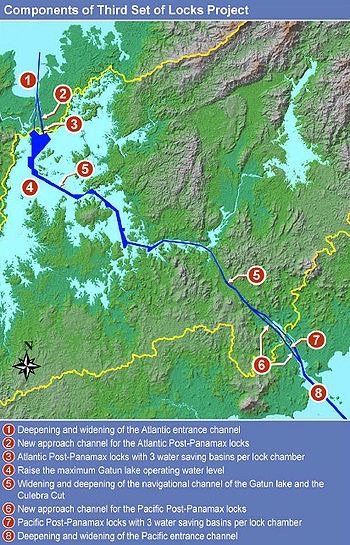
  • Map of the New Third Lane  of the Panama Canal and Post-Panamax Elements
    Map of the New Third Lane of the Panama Canal and Post-Panamax Elements
    e

  • http://youtu.be/YzCULxAmkRU
    Approximately one hundred years after President Theodore Roosevelt embarked upon the construction of the original 48-mile-long Panamal Canal,  the Republic of Panama began the final steps toward the completion of a more modern waterway in the summer of 2015.

    The new project modernizes Lake Gatun and the the most difficult of the original cuts, the Culebra Cut, through nearly incorrigible  mountainous terrain.  So arduous was the Cut, the work hospitalized its manager, Col. David Gaillard, cousin of James L. Colee, the longest-serving director of the privately owned Florida canal company that would finance and build (1881-1912) what would become the toll-free federally controlled Florida section of the Atlantic Intracoastal Waterway in 1929.  James’s cousin David would not be able to attend the opening ceremonies of the completion of the Panama Canal in 1914, led by the Army Corps of Engineers.

    This videotape summarizes the one-hundred year-long history of one of America’s most expensive capital projects outside the United States to its controversial turnover to the Republic of Panama to Panamax, the modernization of the Panama Canal and the addition of a third modern lock to meet the challenges of  larger cargo vessels of the twenty-first century.  Tap on the link at the top of the new page after clicking the link at the top of this page.

  • A World Heritage Site in southern France, this aqueduct bridge was built during the Roman occupation around the beginning of the Christian Era.

    Pont du Gard the bridge aqueduct built by the Romans around the beginning of the Christian Era over the River Gardon from a stream to the Roman settlement T Nimes.
    Pont du Gard the bridge aqueduct built by the Romans around the beginning of the Christian Era over the River Gardon from a stream to the Roman settlement T Nimes.

    Because of the passage of time, only partial lengths of Roman aqueducts remain in various states of repair throughout Great Britain and Europe, wherever the Roman Army occupied the land. It is one of the most important tourist attractions in France.  Roman engineers, contractors, and workers built the aqueduct bridge on three tiers of water-tight stonework laid without mortar or bond of any kind.  The first level rests on six arches, the second, on eleven arches, and the third or top level carrying the water on thirty-five arches. In total, the bridge rises 160 feet from the river bed.  The aqueduct was built to carry water from a stream over the River Gardon to the Roman settlement at Nimes in the south of France twenty-five miles away.

    The workmanship was so exacting that in many cases cement or other bonding products were not necessary to create precise sealants in the granite stonework. No mortar cement was used in constructing water-tight lengths of aqueduct.  There is another example of exacting Roman engineering and construction in Spain.   The Aqueduct of Segovia was also built around the beginning of the Christian Era with such precision the twenty-mile length carried water into and around Segovia until it fell into disuse in the Nineteenth century. It, too, was built without bonding or a sealant of any kind.  The Aqueduct at the Gardon River to Nimes in France and the Aqueduct to Segovia in Spain are the only two Roman bridge aqueducts known to survive from the Roman period.

  • Hubble Telescope:  Tip of the ‘wing’ of the Small Magellanic Cloud galaxy

    http://pocket.co/soY5qt

    To see this spectacular image, double click on the link to the Pocketed image.

    In so doing, it will fill the screen with this beautiful work of nature.

    It is difficult to imagine a universe so complex and yet so beautiful could be simply creatio ex nihilo.

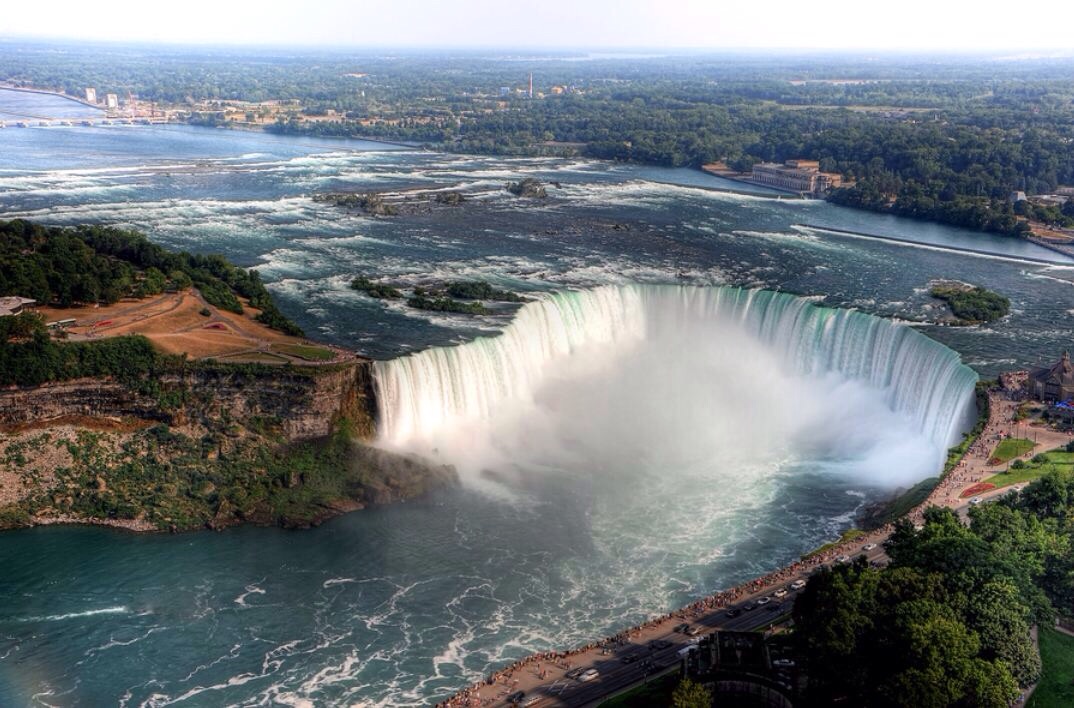
  • Niagara Falls: America's outdoor wedding venue
    Niagara Falls: America’s outdoor wedding venue
  • Lake Victoria Falls, Zimbabwe, Africa
    Lake Victoria Falls, Zimbabwe, Africa
  • Obviously listed for protection on UNESCO’s listing of World Heritage Sites, Lake Baikal is the oldest lake in the world at 25 million years.  It is the deepest lake in the world at 5,378 feet, and most expansive, occupying over 12,000 square miles of the Earth’s surface.  Lake Baikal contains twenty percent of the unfrozen freshwater on the planet.

    Lake Baikal, the deepest, oldest, and most expansive unfrozen freshwater lake in the world.
    Lake Baikal, the deepest, oldest, and most expansive unfrozen freshwater lake in the world.

    The climatic asymmetry accounts for the unique variety of plants and other flora.  The western basin has light coniferous forests and mountain steppes while in the eastern basin, pine forests predominate.  Mountains completely surround the lake.  The advancing and retreating of glaciers did not scour the bottom of this high altitude lake, as in the case of other high altitude lakes during the ice age.

    Lake Baikal supports 1,700 plants and animals, two-thirds of which can be found no where else in the world.  Thus, it is one of the most bio-diverse lakes on the planet.