Florida’s Big Dig
The story of the Intracoastal and other thoughts on water, waterways, land, and ecology
-
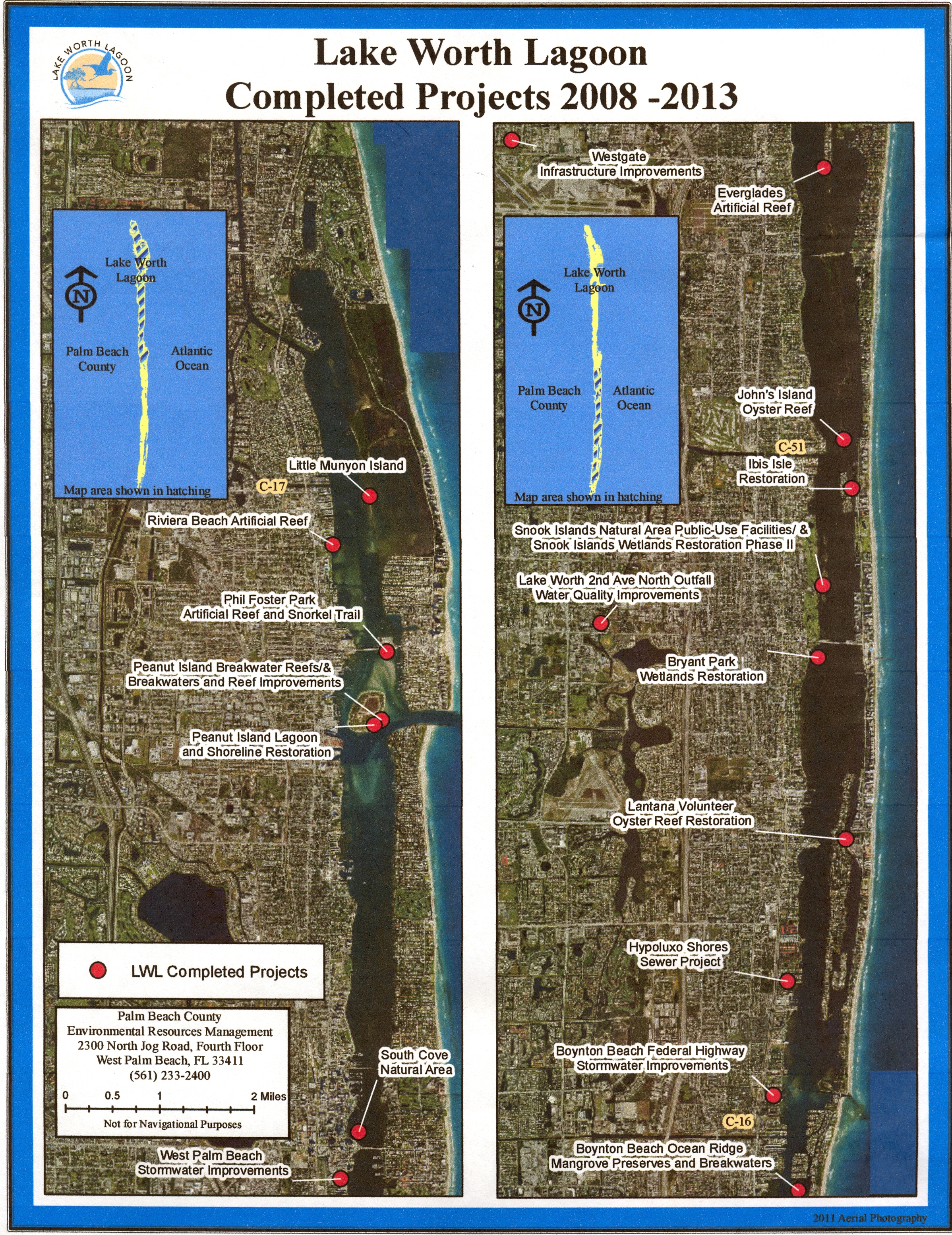
This map shows the environmental projects affecting in some way the use, conservation and protection of the Lake Worth Lagoon and its biota, lying entirely within Palm Beach County, Florida. County government led the prosecution and completion of these projects. In many cases, other entities such as FIND, Florida Department of Environmental Protection, and others may have participated in providing grants, loans, and in-kind goods and services. -
The History of Broward County’s Colored Beach and the Wade-Ins of the Fort Lauderdale Beaches of the Summer of 1961
http://www.historymiamiarchives.org/pdfs/Tequesta2007-p19-51.pdf
Please press above line for published journal article.
-
For many, the topic of ‘saving our water’ immediately causes the rolling of eyes much like the late British comedian Marty Feldman in “Young Frankenstein.”
But only a cursory review of my posts on the National Drought Monitor makes us realize that Our supply of potable water is limited. Southern California is experiencing its fifth year of extreme drought. Lakes and reservoirs are drying up. The cost of desalination of water for even a medium-size American city is in the billions, not millions, of tax dollars. (One day the American taxpayer will realize that bonds must be paid back just like any other indebtedness.) Conserving water is good for the environment and good for the taxpayer. Nothing is free, not even water.
The following leads to ‘apps’ for use in irrigation dependent upon the different uses made of our land. http://smartirrigationapps.org
One should read it if for no other reason than our tax money was probably expended in some way in producing it. Jointly, the University of Florida, the University of Georgia, and IFIS produced these apps. Besides, it makes good sense for any community to conserve our water and land on rational grounds as well as on ethical and moral grounds as trustees and stewards of this ‘good Earth’, this one planet. Or we may well end up like California, wondering whence our next cup of potable water will come.
-
Two thousand years ago, the land was an alluvial plain. Over the next thousand years, the Dutch built dikes around the highest land. In more recent times, the Dutch added the familiar Windmill pumps, and today pumps dot the landscape of The Netherlands to remove water accumulated from the deadliest of storms.
This particular set of gargantuan ‘sea doors or gates’ pictured here automatically closes upon unusual
 level rises when the pressure of the sea pushes the the two ‘sea gates’ together closing off the mouth of a major river running into a highly populated area of the country. Called Maeslantkering, the project concluded in 1997. So far these ‘sea doors’ have closed only once since completion of construction. In response to millions who live under the constant threat of flooding, the government of The Netherlands has built an intricate system relying on dams,levees,and pumps, as well as a system of smaller scale dikes, dams, and secondary lock structures to manage the threat.
Within the last few years, the Dutch government unveiled a $3 billion program called ‘Room for the River’, involving 14 different infrastructure projects over several decades, allowing the sea water in, not out. In 2013, New York Gov. Andrew Cuomo ‘floated’ a similar program for low-lying areas in New York City. It’s worth considering. If there is any country this country should look to for a paradigm in intelligently managing the water, it is undoubtedly The Netherlands. They’ve been doing it successfully for hundreds of years.
 Florida’s Big Dig