Florida’s Big Dig

The story of the Intracoastal and other thoughts on water, waterways, land, and ecology

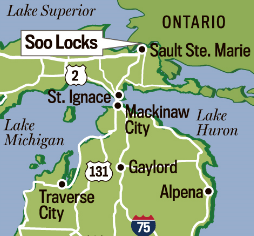
  • Map of the Soo Locks, Sault Ste. Marie, Michigan.
    Jim Map of the Soo Locks, Sault Ste. Marie, Michigan.

    This is a simplified but detailed sketch or map of the Soo Locks. These locks allow access to the minor or lower Great Lakes from Lake Superior. Thus, for example, large freighters filled with iron ore, coal, and other minerals used in manufacturing steel may be transported from the iron and coal mines ringing the Lake Superior through the Soo Locks, to the manufacturing cities surrounding the minor or or lower lakes beginning with Lake Huron and on through other lakes over the Saint Lawrence River east to the Atlantic Ocean.

  • At Sault Ste. Marie, Michigan, the Soo Locks assist the Great Lakes freighters in transiting from Lake Superior to the minor lakes below like Lake Michigan or the minor lakes to Lake Huron, Lake Erie, and Lake Ontario via the Welland Canal (parallel to the Niagara Falls) to the Saint Lawrence Seaway, and finally to the Atlantic Ocean.

    MAP OF NORTH AMERICA AND THE GREAT LAKES

  • image
    The Herbert C. Jackson transiting through the Soo Locks at Sioux Ste Marie, MI.
  • Leaving considerations of potential damage to the St. Lucie estuary aside, the Corps continues to slowly and methodically discharge Lake Okeechobee water to both east and west Florida coasts to reduce the possibility of a catastrophic breach of the Hoover Dike walls and damage to hundred of thousands of acres of farm and environmentally sensitive land as well as loss of life and serious injury to countless numbers. The Corps has lessened the amount and number of discharges.


  • In Part II, we will explore in depth the Atlantic World, the Atlantic Ocean, islands like Bermuda, Jamaica, Latin America and Central America, an continents like the Americas, Mexico, updates on the Panama Camal, Great Britain, Ireland, the Canary  Islands, and such other Island as may strike one’s fancy, human rights, women’s right, technology, and labor.

  • https://vimeo.com/allisonrandolph/estuarystory

    Every year, in the few months before the rainy season hits south Florida, the Army Corps of Engineers begins the delicate and sensitive process of lowering  Lake Okeechobee by three to four feet.

    The Corps utilizes two routes.  The first is the Caloosahatchie River estuary on the west side of the Lake into the Gulf of Mexico.  The second drains the Lake on the east side to the Atlantic Ocean.

    The key to the draining is the  speed at which the existing surrounding environment can safely accommodate the discharge of water over sea grasses, lichen, snails and other nearly microscopic marine animals. In other words, the discharge of water may not strip the bottom land of the food and nutrients that the fish and other larger animals need  for survival.  The Corps must balance the needs of one with the reqirements of the other.

    Within the last several years, citizens’ groups have become more numerous and more vocal with each new discharge of dirty Lake water into and through the St. Lucie Inlet.  Dirty water or worse, brown blooms, means no or severely reduced seafood production for people whose livelihoods depend upon fishing and the expectations of the consumer who expects good seafood at reasonable prices.

    As this video (see link above) demonstrates, we have demanded water.  As the population has grown, the needs of more consumers demand more clean water and more seafood.  One voice in the video says,  it’s time to stop the ‘blame game’.  The time is now to fix the mistakes of the past that overlooked the impact of growth on the environment.


  • The feature displayed at this post is a computerized scenario of Panamax cargo vessels as long as three American football fields and as wide as the largest cargo vessels made today transiting from the Atlantic Ocean to the Pacific Ocean or vices -a-versa.

    As these vessels proceed through the locks, as many as six pilot boats will be needed for each cargo vessel under its own power, whereas the replaced system required railroad engines parallel to the vessel to pull each cargo vessel through the locks without damage to the side walls.

    The entire system is carefully controlled by a bank of computers, sophisticated video monitors, and control systems to keep each vessel from hitting the sidewalks, some, inches away from the widest beam of the largest vessel.

    Over 100 years ago, American companies completed the original Panama Canal after the French gave up its franchise as a result of the deaths of thousands of workers who succumbed to the bites of a particular mosquito.  President Theodore Roosevelt completed the Panama Canal from 1904 to 1914 through the intelligence, skill, and hard work of three men, whom I have denominated the three “G’s”.

    Gen. George Goetthals of the Army Corps of Engineers, who superintended the project; Dr. William Crawford Gorgas, who discovered the particular mosquito whose bite caused dengue and yellow fever and then eradicated the deadly diseases through comprehensive sanitation procedures such as the removal of standing water and other breeding grounds for the insect; and finally, Col. David Gaillard, who superintended the most difficult work on the project.  Gaillard’s task was to blast through a mountain eight miles wide using dynamite to create the vital Culebra Cut. The Cut was originally known as the Gaillard Cut.

    Gaillard’s work was so arduous, it literally broke down  his health, leaving him completely incapacitated.   Not only was Gaillard unable to see the completion of the work, he was confined to Walter Reed Hospital in the nation’s capital when the work of the Canal was finally completed in 1914. He died soon thereafter. For my money, Gaillard’s name should be restored to its identification with the Cut  He deserves it.  For those of you who have read my book,”Florida’s Big Dig,” you will recall that David was a cousin of Henry Gaillard, one the four incorporators of the private Florida canal company that built what would become the Intracoastal Waterway from 1881 until 1912.

    Enjoy this well-made video of the operating of the new Panama Canal when complete.

    .http://youtu.be/DrQrKAku3e0